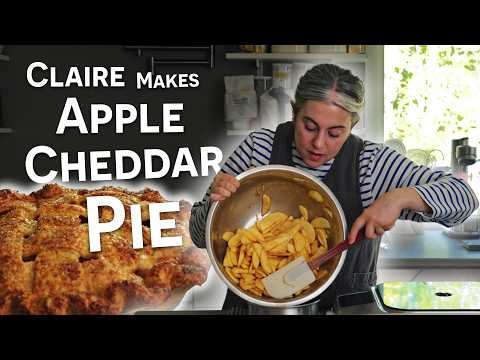
Apple cheddar pie with a cheddar butter crust and caramelized cream filling
American cuisine › New England · Claire Saffitz x Dessert Person · ♥ 6.7K likes · 335.6K views · 47 min video
No ratings yet
Read about fruit pies in the BrightCulinary Book
Timestamp
Ingredients
Method
Techniques
- 3 lb honey crisp apple
Pre-cook the fruit filling to drive off liquid, so the pie is not soupy with a soggy bottom crust.
Peel each apple in a ring round the top and bottom and then lengthwise around. Peel all the apples first, core them all, then slice them all.
Cut the flesh away from the core on four sides, then slice about a quarter inch thick, lengthwise or crosswise.
- ⅔ cup demerara sugar
Toss 3 lb sliced apples with 2/3 cup demerara sugar, a pinch of kosher salt and 1 tsp ground cinnamon.
Tossing the apples with sugar and flavorings
- kosher salt
- 1 tsp ground cinnamon
- 2 tsp vanilla extract
- 2 tsp apple cider vinegar
- 2 tsp orange bitters
- ⅔ cup heavy cream
- 2 tbsp cornstarch
Add 2 tsp vanilla extract, 2 tsp apple cider vinegar and 2 tsp orange bitters, and toss to coat the apples fully.
Let the mixture macerate, holding back the cream and cornstarch. Sugar is hygroscopic and pulls the juices out, which both gives the filling a head start on thickening and softens the apples. Half an hour works, a couple of hours is better, overnight in the fridge better still; the acid and sugar keep them from browning.
How maceration softens the apples
Softening matters twice over: it gives a silky spoonable texture, and collapsed cell walls let the fruit be packed tight at assembly, which is what prevents the gap between crust and filling.
- 4 oz cheddar cheese
Grate 4 oz aged cheddar with the grating disc of a food processor.
- 3 cup all-purpose flour
- 2 tbsp granulated sugar
- 2 tsp diamond kosher salt
- 2 stick unsalted butter
- ⅔ cup ice water
Swap in the blade and add 3 cups all-purpose flour, 2 tbsp granulated sugar, 2 tsp diamond kosher salt and 2 sticks of cubed chilled unsalted butter.
Flour, sugar, salt and cold butter
Pulse just a couple of times, barely breaking the butter down, keeping pieces big enough to make flaky pockets.
Pulsing in the ice water
Pour in 2/3 cup ice water and pulse until the butter is between the size of a lentil and a pea and the crumbs are evenly moistened, stopping well short of a ball of dough.
Why cheese makes the dough tender
Turn out onto the work surface. The mixture looks crumbly but a squeezed fistful holds together. Pat and press it into a square or rectangle, using a bench scraper from the sides, and take it down to at least half an inch thick with the rolling pin.
Stacking the dough for a quick lamination
Cut into quadrants and stack them on a floured surface, tucking any loose bits between the layers, then press down. This quick lamination flattens the butter into thin sheets for many layers. If the butter softens, chill 5 to 10 minutes.
Wrap each half tightly in plastic, rounding the corners into a disc, then roll over the wrapped dough with the rolling pin. Forcing the dough into the plastic under pressure makes it adhere and cuts down on cracking when it is rolled out.
Caramelize the cream: heat a small saucepan over medium, add the 2/3 cup heavy cream and bring it to as high a boil as it will take without boiling over, whisking occasionally.
Stir 2 tbsp cornstarch with a couple of tablespoons of the apple liquid to a slurry with a fork, so it does not lump, and set it aside.
As the cream reduces it breaks into butterfat and solids. Cook it to golden brown, whisking so the milk solids do not stick and burn. It is a more intense version of brown butter, since cream carries more milk solids than butter.
Pour all the pooled juices from the apple bowl into the saucepan and reduce by about two thirds, until the bubbles get bigger and slower to pop and the juices are syrupy.
Whisk the cornstarch slurry in, stirring it again first, and bring it to a boil to activate the starch, whisking to prevent lumps. It thickens a lot.
Pour the mixture back over the apples and toss to coat. Adding the liquid and cornstarch to the browned cream re-emulsifies it, so no fat pools on top. Let it cool before assembly.
Roll one portion of dough on a floured surface, keeping it moving and rotating it, to a slightly oblong round between a quarter inch and an eighth of an inch thick, closer to an eighth.
Rolling and cutting lattice strips
Cut ten strips about one and a half inches wide with a wheel cutter, in a variety of lengths, and chill them. The cheddar makes this dough more delicate than usual, because it gets in the way of the gluten chains that give structure and elasticity.
- 1 whole egg
- heavy cream
Preheat the oven to 425F and make the egg wash from one egg and a splash of heavy cream.
Preheating and setting up for assembly
Roll the second portion onto the rolling pin and unroll it over the pie plate.
Lining the pie plate
Press the bottom crust in firmly, letting the weight of the dough settle into the corner where base meets side rather than stretching it, for full contact with the plate all the way round. That contact and the heat conducted through the plate is what browns the crust.
Add the apples and press them down hard, packing the filling as tight as it will go to keep the air gap out. Aim for a gentle mound.
Packing in the filling
Lay the longest strip across the centre, a second at 90 degrees, then work outwards to the edges with shorter strips, weaving over and under and keeping them parallel and square. Five strips each way.
Trim the strips back to the rim with scissors, press the edge down firmly onto the egg washed border, then trim the bottom crust to about half an inch of overhang.
Trimming and folding the edge
Egg wash the whole border including the strip ends and fold the overhang up and over, resting the doubled dough on the rim.
Crimp with thumb and forefinger in a first pass, then pinch to define and even the thickness, and pinch back the other way. The crimp is not only decorative: it increases surface area and thins the border so it bakes through. Avoid a thick edge and an overhanging crimp, which breaks off in the oven and loses definition as the crust puffs.
Why the crimp matters
- demerara sugar
Egg wash the lattice and crimped edge, avoiding pools inside the crimp, which darken fast, then sprinkle demerara sugar over the surface and border.
Freeze 10 minutes so the edge sets. The colder it goes in, the more dramatic the puffing and the flakier the layers.
Egg wash, sugar and the freezer
Bake on a foil lined baking sheet on the centre rack at 425F for 20 minutes, then turn down to 350F for the rest, one hour 15 to one hour 45 in total, until the pastry is deeply browned and the juices are bubbling. This one took one hour 25.
Cool completely on a rack, several hours, so the filling sets. Warm a cooled slice rather than cutting it hot.