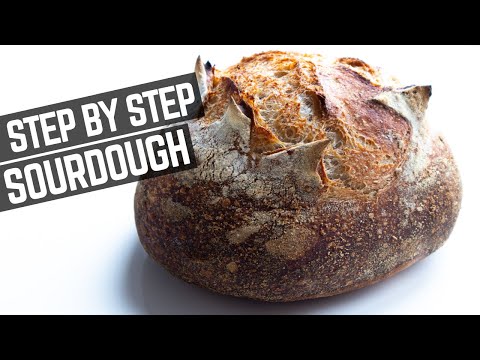
Country sourdough bread
Brian Lagerstrom · ♥ 4.2K likes · 159.3K views · 12 min video
Read about loaves in the BrightCulinary Book
Timestamp
Ingredients
Method
Techniques
- 10 g active sourdough starter
- 25 g room temperature water
- 25 g all-purpose flour
Discard all but 10 g of active starter, add 25 g room temperature water and 25 g all-purpose flour, mix, and leave on the counter overnight.
Feeding the starter the night before
- 84 g water
- 42 g starter
- 84 g AP or bread flour
The next morning, around 8 a.m., build the refreshment: 84 g of 90 to 95 degree water, 42 g of the overnight starter and 84 g of AP or bread flour. Mix to combine and set aside.
Building the refreshment
- 238 g warm water
- 292 g bread flour
- 42 g whole wheat flour
For the autolyse, mix 238 g warm water with 292 g bread flour and 42 g whole wheat flour, starting with a spoon and finishing with wet hands to work out the clumps.
Wrap and rest two hours; hydrating the flour before the leaven and salt go in makes the dough more extensible.
How to make a sourdough starter
Aside, to build a starter from scratch: day one, 100 g water and 100 g flour mixed and left 24 hours; days two and three the same but discarding 90 percent first; days four through seven feed twice a day with equal parts water and flour. By day seven it should gas, smell sweet, then sour, then collapse over 12 hours.
- 10 g salt
- 167 g refreshed starter
Check the refreshment by floating a spoonful in warm water; it should float.
Combine the autolyse with 167 g of the refreshment first, then lay 10 g of salt on top and leave 20 minutes so it draws a brine.
Fold: grab a corner, pull to resistance and flip it to the other side of the bowl, five or six times around. Do two rounds, without tearing.
Ferment on the counter about three hours, longer in a cool house, until buoyant, springy and grown by about 50 to 60 percent.
Turn out onto a well floured surface and pre-shape: pull and fold a corner five or six times around, flip seam side down, then push and curl from 10 to 2 to build tension.
Final shape: flip so the seam faces up, pull and fold the corners six or seven times until tight, flour the hands, flip, and repeat the 10 to 2 push and tuck.
Proof on the counter one to three hours until it grows about 50 to 60 percent and feels full of gas.
Preheat the oven to 500F with the Dutch oven or stone inside for 45 minutes.
Preheating the vessel and why steam matters
- semolina flour
Flip the loaf onto parchment or semolina flour and score it: a square cut with a serrated knife, a cross cut with scissors, or a random slash pattern.
Load with the lid on, turn the oven down and bake 18 minutes.
Remove the lid, drop to 450F and bake another 30 minutes to a dark golden, almost reddish brown; it sounds hollow when tapped underneath.
Cool at least two hours before cutting, or the crumb stays squishy and the shelf life suffers.
Cooling before cutting, and tasting