Part 3 · Ingredients
11Meat and poultry
See the Chicken recipes →See the Turkey recipes →See the Duck recipes →See the Beef recipes →See the Veal recipes →See the Pork recipes →See the Lamb recipes →
Meat, poultry and seafood are the hardest foods in a kitchen to store, and the most expensive things a restaurant sells. A cook who knows where a cut comes from on the animal can predict how tender it will be, and so which cooking method will suit it. A muscle the animal used all day, such as the shoulder, is full of connective tissue and is tough, though often full of flavor. A muscle that did little work is tender.
Every carcass is broken down in the same order. It is split, then cut into large sections called primal cuts, and these are cut again into the smaller pieces a kitchen cooks: subprimal and fabricated cuts. Knowing where the bones lie makes the cutting and carving easier and helps you name the cut in front of you.
11.1 Chicken and other poultry: kinds and fabrication
Chicken recipes → Turkey recipes → Duck recipes →
What counts as poultry
Poultry is the name for birds that are kept and bred to be eaten: chickens, ducks, geese, guineas, pigeons and turkeys. Wild birds that are hunted for sport or for food are not poultry. They are game. The United States Department of Agriculture (USDA) recognizes the same six kinds, and divides each kind into classes, mostly by the age of the bird and how tender it is.
Poultry is usually the cheapest main-dish food a kitchen buys, and one of the most flexible. Its mild taste goes with a long list of sauces and side dishes, and nearly every cooking method works on it.
Inside the bird
By weight, chicken muscle is about 72% water and 20% protein, with 7% fat and 1% minerals. Unlike red meat, poultry has no marbling, the thin streaks of fat inside the muscle. A bird stores its fat under the skin, inside the body cavity and in a pad near the tail. This fat is soft, melts at a lower temperature than other animal fats, and renders (melts out) easily during cooking. Rendered chicken fat is called schmaltz in Jewish cooking. Sealed and refrigerated, it keeps well and makes a tasty cooking fat that saves money.
The breast and wings of chickens and turkeys are pale. The thighs and legs are darker. The color comes from myoglobin, a protein that holds oxygen for a working muscle. Chickens and turkeys hardly fly, so their breast muscles need little myoglobin. A bird that flies has dark meat all over. Dark meat also has more fat and connective tissue than white meat. It needs longer cooking, and roasting and braising suit it well.
Skin can be white, golden yellow or anything between; the feed decides it. Skin color is not a sign of quality.
Age decides the method
Muscles that work hard are tougher, and an old bird is tougher than a young one. Most poultry reaches the market young, so most of it is tender. Every part of a small, young bird can be cooked with dry heat. Hens that have stopped laying eggs are sold as stewing hens or boiling fowl. They need moist heat, and they go into pot pies, stews and soups. With young birds, male or female makes no difference to the cook. With older birds it does: old males are tough and stringy, with less flavor than old females.
Dry heat is taught in full earlier, and so are braising and stewing. see chapter 8: Dry heat: sauté, grill, roast, fry see chapter 10: Slow and low: braise, stew, sous vide
Chicken
Chicken is the most widely eaten poultry in the world. It has light and dark meat and fairly little fat. Almost any method suits a young chicken, while an old one does best stewed or braised.
| Class | Age | Weight | Suits |
|---|---|---|---|
| Game hen | 5 weeks or less (also given as 5 to 6 weeks) | 2 lb (1 kg) or less | Split and broiled or grilled; roasted |
| Broiler or fryer | 10 weeks or less (also given as 13 weeks) | up to 3 lb 8 oz (1.5 kg) | Any method |
| Roaster | 8 to 12 weeks (also given as 3 to 5 months) | 3 lb 8 oz to 5 lb (1.5 to 2 kg) | Any method |
| Capon | 4 to 8 months (also given as under 8 months) | 6 to 10 lb (2.5 to 4.5 kg) | Roasting |
| Hen or stewing fowl | over 10 months | 2 lb 8 oz to 8 lb (1 to 3.5 kg) | Stewing or braising |
Chicken classes by age and weight. Where a class has two ages, both figures are in use.
- Game hens are young birds bred from Cornish chickens crossed with White Rock chickens. They are full of flavor and weigh one to two pounds. The French name is poussin. Split them and broil or grill them, or truss them and roast them whole.
- Broilers and fryers are young and lean, with soft, smooth skin, and any method works. For grilling, many cooks spatchcock the bird: they cut out the backbone, break the breastbone and pull out the breast cartilage, so the bird lies flat. It is then seasoned, grilled under a brick, and turned to finish.
- Capons are male chickens that were castrated and fattened. They are bred for flavor, with a high share of white meat. They weigh 5 to 7 pounds and are often roasted, though some reach 10 pounds. They were once a favorite of the garde manger for cold platters.
The French poulet de Bresse is often called the finest chicken in the world. It is the only chicken with a certified place of origin: a blue-legged, free-range bird raised near Bresse in Burgundy and fed milk products, sweet corn and grain. Each genuine bird is sold with a band on its leg.
Duck and goose
A duck (French canard) has only dark meat. Treat the breast and the legs as if they came from two different animals. The breast is red meat, cooked in a sauté pan to rare or medium rare. The legs, by contrast, must be cooked well done before they are tender enough to eat, so braise, roast or stew them.
Poultry must reach 74°C (165°F) inside, held for 15 seconds. Restaurants do not take duck breast that far, against the food safety rule, because at 165°F the breast turns dry and tastes of liver.
Ducks carry a great deal of fat, which helps them float. Cooks call it white gold and always render it, then use it as the cooking fat for duck confit and for pommes de terre sarladaises. Ducks also have a lot of bone for their size, so the carcass makes good stock. The three ducks most often eaten are the Muscovy, the Mallard and the Pekin.
A duckling is a duck killed before it is eight weeks old. The roaster duckling is the one kitchens use most. Because of all that bone and fat, a 4-pound duck feeds two, but a roasting chicken of the same weight feeds four. The fatty skin is only pleasant to eat once as much fat as possible has been rendered out. A magret is a duck breast, traditionally from the ducks raised for foie gras. It is large and usually served boneless with the skin on.
| Duck class | Age | Weight | Method |
|---|---|---|---|
| Broiler or fryer | 8 weeks or less | 3 lb 8 oz to 4 lb (1.5 to 1.8 kg) | Roast at high temperature |
| Roaster | 16 weeks or less | 4 to 6 lb (1.8 to 2.5 kg) | Roast |
| Mature | 6 months or older | 4 to 6 lb (1.8 to 2.5 kg) | Braise |
USDA classes of duck.
A goose also has only dark meat, and its skin is very fatty. Cooks roast it hot so the fat renders out. Roast goose is a holiday dish, often served with a sharp fruit sauce, a gastrique, whose acid balances the richness. A young goose (about 6 months, 6 to 12 pounds) is roasted hot. A mature goose (over 6 months, 10 to 16 pounds) has tough flesh and is braised or stewed.
Turkey, guinea fowl, squab and ratites
Turkey (French dinde) is the second most popular poultry in the United States, after chicken. It has light and dark meat and fairly little fat. Turkey has four classes.
- Fryer-roaster: 16 weeks or less, 4 to 9 pounds.
- Young: 8 months or less.
- Yearling: 15 months or less.
- Mature: older than 15 months.
The youngest can be roasted, sautéed or pan-fried; the older classes go to stewing and processed products. Younger turkey is good value and can be cooked almost any way. Cooks pound turkey into thin cutlets, bread them and sauté them as they would veal for schnitzel, and braised turkey makes a comforting pot pie. Wild and farm-raised turkeys look and taste different.
The guinea fowl (French pintade) descends from a game bird. It has light and dark meat with a taste like pheasant, and young birds are ready at about four months. The breasts are tender enough to sauté. The bird is so lean that it is larded or barded, covered in fat, before roasting. It costs more than chicken and is less popular in the United States than in Europe.
A squab is a young pigeon, taken before it can fly. Pigeons have only dark meat, and squab is very tender. It is popular in Persian restaurants. Squabs are 26 to 30 days old and about 500 g (18 oz) when they leave the nest.
Ratites are flightless birds with small wings and flat breastbones: the ostrich, the emu and the rhea. All three count as red meat, with little fat or cholesterol. Ostrich is said to taste best, and any of them can be cooked the way you would cook lean, delicate veal.
Giblets and foie gras
The giblets are the liver, gizzard, heart and neck. The gizzard is a second stomach that grinds the bird's food. Necks are full of flavor and go into stock with the carcass. Livers, hearts and gizzards stay out of stock, because their taste is too strong. Each giblet has its uses:
- Chicken livers are sautéed or broiled with onions, or made into pâté.
- Gizzards are trimmed and deep-fried.
- Hearts are sautéed or creamed.
- All of them can go into giblet gravy.
Foie gras is the swollen liver of a duck or a goose that has been fattened by force-feeding. Many countries ban this feeding for the sake of animal welfare. A good one is smooth, round and putty-colored, never yellow or grainy. Goose liver is paler and milder; duck liver tastes deeper and is used more often. The liver has two lobes, which are pulled apart and the veins removed.
Foie gras is so fatty that too much heat melts it away. For hot dishes it is seared fast over high heat in slices 15 to 25 mm thick, which leaves the middle rare. No oil is needed in the pan, because the liver gives off plenty of fat; keep that fat for other dishes. For a cold dish au torchon ("in a towel"), a whole lobe is shaped, wrapped in a cloth, cooked slowly in a water bath, then pressed and served cold in slices.
Breaking down a bird
▶ LectureRaw chicken often carries salmonella, so work clean from the start. A well-set station holds:
- the recipe, under plastic film;
- butcher's twine in a small pan;
- a half sheet pan lined with parchment for the finished pieces;
- the chicken in a pan over ice;
- a sanitized cutting board on a damp towel, so it cannot slide;
- the tools, laid on a folded towel, with sanitizer kept under the table.
Knife skills are covered earlier. see chapter 4: Knife work
Most of the cuts a kitchen uses come from a few simple steps.
- Half. Cutting the bird in half is often the first step, and it gives two portions of a broiler or fryer. The backbone and the keel bone (breastbone) come out, for a neat result. Keep the backbone, breastbone and wing tips for stock.
- Quarters. A bird can be split lengthwise through the backbone and keel bone, or across into a front quarter (breast and wing) and a hindquarter (the legs).
- Cut-up (8-cut). Cutting through the soft joints gives the best yield. An 8-cut chicken is two drumsticks, two thighs, and the two breasts each split across the rib bone, with the wing sometimes left on one half. It is always cut with the bone in; the pieces can be boned and skinned afterwards.
- Wings. A wing breaks into three parts: the tip, the winglet and the drumette.
- Supreme (airline breast). A breast with the drumette of the wing still attached.
- Tenderloins and cutlets. The tenderloins (fillets) can be pulled off the underside of the breast. What remains of the breast can be halved and pounded flat into a thin cutlet, the paillard.
- Legs. Cut the leg through the knee joint to part the thigh from the drumstick. Drumsticks usually stay on the bone. Thighs are often boned and skinned, then sliced or diced for stir-fries. A boned, stuffed leg is called a ballotine.
Chicken halves are a favorite for Southern barbecued chicken.
- Brine them for flavor and moisture, but for no longer than 24 hours.
- Pat them dry with paper towels.
- Leave them in the cooler for several hours to form a pellicle, a dry, tacky skin.
- Grill or smoke them. Brush on barbecue sauce only near the end, because its sugar burns.
11.2 Inspection, grading and storage
Inspection is not grading
In the United States, the USDA runs two separate programmes. Inspection checks that meat and poultry are wholesome, which means safe and fit to eat. It is required by law and paid for with public money. Grading judges quality. It is voluntary, and the producers who ask for it pay for it. The agency that inspects is the Food Safety and Inspection Service (FSIS). Early inspectors looked mostly for sick animals. Today they also look for dangers nobody can see, such as germs and chemicals.
Meat that passes is stamped with a round purple mark, made with a food-grade vegetable dye that does no harm. The mark goes on carcasses and large cuts, so it may be trimmed away before a steak reaches you, but a package from an inspected plant shows a mark naming the plant. On poultry, the round stamp is on a tag on the wing or printed on the package. An inspection stamp tells you nothing about quality or tenderness. Animals the law does not cover, such as bison, rabbit, elk and deer, can be inspected on request for a fee.
Beef grades
Beef is graded as a whole carcass, in two ways. Quality grades judge tenderness, juiciness and flavor, from the marbling, the color and the age of the meat. Yield grades judge how much usable lean meat the carcass holds. Marbling is the white flecks of fat inside the muscle. More marbling means a higher grade, because it makes beef more tender, tasty and juicy.
| Quality grade | What it means | How to cook it |
|---|---|---|
| Prime | Young, well-fed cattle; plenty of marbling; sold mostly to restaurants and hotels | Dry heat: roast, broil or grill |
| Choice | High quality, less marbling than Prime | Loin and rib cuts by dry heat; rump, round and blade chuck by dry heat only if not overcooked, and most tender braised |
| Select | Even quality, leaner, may be less juicy | Dry heat only for loin, rib and sirloin; marinate or braise the rest |
| Standard, Commercial | Often sold as ungraded or store-brand meat | |
| Utility, Cutter, Canner | Rarely sold in shops | Ground beef and processed products |
USDA beef quality grades.
Only about two percent of graded beef is Prime. It is the most tender and flavorful, and also the fattest. Most graded beef in shops is Choice or Select. Protein, vitamins and minerals are much the same in every grade. Yield grades run from 1, the most lean to fat, down to 5. Cooks rarely see them, except when buying a side or a whole carcass. The words Prime, Choice and Select may not be used for raw pork or poultry.
Veal, lamb and pork
Veal has five grades: prime, choice, good, standard and utility. The top two are juicier and tastier. Because the animal is young, the meat is pale, from light grayish pink to light pink, with a firm, velvety feel. Its bones are small, soft and red. Chops can be roasted, grilled or broiled.
Lamb also has five grades, but shops usually sell only prime and choice. The lower grades, along with mutton (meat from older sheep), are seldom marked. Lamb quality changes with the age of the animal, so graded lamb is the safer buy. Most prime and choice cuts can take dry heat; the breast, riblets, neck and shank are braised.
Pork does not get USDA quality grades, because it comes from young animals bred and fed to be evenly tender. Choose it by eye instead: a thin layer of outside fat, firm grayish-pink meat, and a little marbling.
Poultry grades
Poultry is graded A, B or C, and the grade appears on a shield-shaped tag or on the package. Grading is voluntary, yet nearly every bird is graded. A Grade A bird:
- is well shaped;
- has thick flesh and a good layer of fat;
- has no pinfeathers, cuts, tears, broken bones or discolored patches;
- if frozen, shows no damage from handling.
Nearly all poultry sold is Grade A; Grades B and C go into processed products. Necks, wing tips, tails, giblets and ground poultry have no grades at all.
The grade says nothing about tenderness or flavor. The class does: a young turkey is younger and more tender than a yearling.
What color tells you, and what it does not
The red of meat comes mostly from myoglobin. Cut meat kept away from air, as in a vacuum pack, is purplish. Air turns the surface bright red. Over time, light and air turn it brownish red. None of these changes alone means the meat has spoiled.
Each fresh meat has its own best color:
- beef: cherry red;
- lamb: dark cherry red;
- pork: grayish pink;
- veal: pale pink.
Ground beef can be red outside and grayish brown inside simply because air has not reached the middle.
Spoiled meat does more than change color. It smells off, feels sticky or tacky, or turns slimy. Do not use it. White, dry patches on frozen meat are freezer burn. The meat is still safe, but those spots are dry and tasteless and can be cut off. The red juice in a package of beef is not blood. It is the meat's own water mixed with protein.
Ground beef
In the United States, beef fat can go into hamburger, but none may be added to ground beef, and neither may hold more than 30 percent fat. Grinding spreads whatever germs were on the surface all through the meat, and exposes more surface to them. E. coli O157:H7, a dangerous germ linked to undercooked ground beef, survives the refrigerator and the freezer.
Ground meat must reach 70°C (158°F) inside. Check ground beef with a thermometer. Grinding beef at home is best avoided, since whole cuts are usually not tested for E. coli the way beef trimmed for grinding is.
Buying poultry
Poultry comes in many forms:
- fresh or frozen;
- whole or cut up;
- with or without bones;
- ground;
- portion-controlled (P.C.);
- individually quick-frozen (IQF).
Whole fresh birds cost less than cut or frozen ones, and they are easy to cut up yourself. Let your menu, your labor costs, your storage and your staff's skills decide which form to buy. Buy only from approved suppliers you trust. Whole birds save money but take labor. For large batches of fried chicken, buying cases of cut pieces makes sense; for a fine-dining airline breast, a cook's own knife work beats a pre-cut one.
Storing meat and poultry
Receiving, cold storage and rotation are covered earlier. see chapter 2: Receiving a delivery
Refrigerated food is kept at 4°C or colder, and raw products always go on shelves below cooked or ready-to-eat food. The rules for meat and poultry:
- Carcass meat is unwrapped and hung so air moves around it, at 1°C to 3°C, in a walk-in, with absorbent paper underneath to catch drips.
- Boned meat keeps no more than three days. Individual cuts are used within two days, and best on the day they are cut.
- Steaks, chops, stewing meat and ground meat sit covered, on trays of plastic or stainless steel, at 2°C to 4°C.
- Fresh poultry is packed in ice and kept in the refrigerator.
- Frozen food is kept at −18°C (0°F) or colder. Meat burns easily in the freezer if it is not wrapped well.
How long poultry and meat keep:
- Chickens and other small birds: up to two days on ice or at 32°F to 34°F (0°C to 2°C).
- Larger birds: up to four days.
- Frozen poultry kept at 0°F (−18°C) or colder: up to six months.
- Ground beef and variety meats (liver, kidneys, tripe, sweetbreads, tongue): only 1 or 2 days.
Set poultry on drip pans so the water drains away, and lay bagged ice over it to keep it colder than the refrigerator alone.
Thaw frozen poultry slowly in the refrigerator: two days for a chicken, up to four for a large bird. Never cook poultry that is still partly frozen. It will not cook evenly, and the frozen spots may never get hot enough to kill bacteria. Beef can also be thawed in cold water in a sealed bag, with the water changed every 30 minutes, or in the microwave; meat thawed either of those ways is cooked straight away. Never thaw meat on the counter.
Raw poultry on the board
Poultry is a potentially hazardous food. It spoils fast and is especially likely to carry salmonella. To keep it from contaminating other food:
- Clean and sanitize every surface, board, knife and tool that touches it before it touches anything else.
- Keep its juices and trimmings away from other food.
- Never put cooked food in a container that held the raw bird.
- Sanitize kitchen towels used during butchering before using them again.
It is not necessary to wash raw beef, because cooking destroys any bacteria on the surface.
Because poultry tastes mild, cooks often marinate it for extra flavor and moisture, especially before broiling or grilling. A mix of white wine or lemon juice with oil, salt, pepper, herbs and spices works well. Poultry soaks up flavor fast. In an acid marinade, two hours is often enough; small pieces need less, and more than a few hours can make the meat too soft. Allow about 240 mL (8 fl oz) of marinade for each double chicken breast. Drain an oily marinade well, so the grill does not flare, and wipe the surface dry so it browns. You may baste with the marinade during cooking, but never serve leftover marinade uncooked or use it again.
Stuffing is a potentially hazardous food, and cold food is stored at 4°C (40°F) or colder. When stuffing a bird:
- Every stuffing ingredient should be cold and stay cold while it is mixed and packed into the bird.
- Stuff the bird as close to cooking time as you can.
- Stuff it loosely, because stuffing swells.
- Close the openings with skewers and twine or by trussing.
- As soon as the bird is cooked, take all the stuffing out and store it on its own; left inside, it cannot cool and bacteria can grow.
Stuffing large birds in quantity is impractical and can be dangerous. It is hard to control the temperature inside, it takes labor, and the longer cooking can dry out the meat.
Is it done?
Poultry must reach 74°C (165°F) inside for 15 seconds, and stuffing cooked in poultry must reach 74°C (165°F).
There are four signs that a roast bird is done, and it is best to use more than one.
- Temperature. Push an instant-read thermometer into the thigh, the last part to cook, and keep it off the bone. It should read 165°F to 170°F (74°C to 77°C) at the coolest point. For a stuffed bird, push the thermometer deep into the stuffing.
- Loose joints. When a bird is done, the leg moves loosely in its socket.
- Clear juices. In a bird that is not stuffed, tilt it with a fork: clear juices from the cavity mean it is done; cloudy or pink juices mean it is not.
- Time. Time alone is the least reliable sign, though it helps plan large batches.
11.3 Beef: primal and subprimal cuts
▶ LectureFrom carcass to primal cuts
After slaughter, the beef carcass is split down the backbone into two halves. Each half is then cut between the 12th and 13th ribs into a forequarter, the front, and a hindquarter, the rear. These four quarters are then cut into primal cuts, and the primals into subprimal and fabricated cuts. A whole carcass can weigh anywhere from 500 pounds (225 kg) to over 800 pounds (360 kg).
| Primal cut | Quarter | Share of carcass | Cuts it gives | Suits |
|---|---|---|---|---|
| Chuck (shoulder) | Fore | about 28% | Cross rib pot roast, short ribs, cubed steaks, stew meat, ground beef, flat iron | Moist heat or braising; flat iron by dry heat |
| Brisket and shank | Fore | about 8% | Brisket; shank | Simmering or braising; shank for soups and stock |
| Rib | Fore | about 10% | Prime rib (rib roast), ribeye, beef ribs (back ribs), short ribs | Roasting; ribs barbecued; short ribs braised |
| Short plate | Fore | about 9% | Short ribs, skirt steak | Short ribs braised; skirt marinated and grilled |
| Short loin | Hind | about 8% | Porterhouse, T-bone and club steaks, strip loin / strip steak, tenderloin | Dry heat |
| Sirloin | Hind | about 7% | Sirloin roasts and steaks (top or bottom), tri-tip | Dry heat: broil, grill, roast |
| Flank | Hind | about 6% | Flank steak (London broil), hanging tenderloin | Flank steak by dry heat or braised; hanging tenderloin any way |
| Round (hind leg) | Hind | about 24% | Top round, bottom round, eye of round, knuckle, shank | Top round and knuckle roasted; bottom round braised |
The forequarter
Chuck. The chuck is the shoulder. The animal uses it all the time, so it holds a lot of connective tissue and is tough, but it is one of the tastiest cuts. It has many bones and small muscles running in different directions, so it is hard to carve whole, and kitchens use it less than other primals. Cuts from it include stew meat, ground chuck, cubed or tenderized steaks, chuck short ribs and the cross rib pot roast. They do best with moist heat or with braising and stewing. The flat iron, from the top of the shoulder, is an exception: a newer steak that can take dry heat. The chuck makes up from roughly 23 percent of the carcass, about 100 pounds, to about 28 percent.
Brisket and shank. These sit under the chuck and form one primal: the breast (brisket) and the front leg (fore shank). Its rib bones and breastbone are always removed first. Once boned, brisket is very tough and quite fatty, and suits simmering or braising. It is often corned to make corned beef, or cured and peppered for pastrami. A whole brisket is sold as the full brisket or as its two parts, the flat and the point. Barbecue cooks favor it, and it is usually cheap. The fore shank is very flavorful and rich in collagen, which turns to gelatin in moist heat. That makes it ideal for soups and stocks, and ground shank helps clarify and flavor consommé.
Rib. The rib holds ribs 6 to 12 and is best known for prime rib. The name has nothing to do with the Prime grade; it means the roast makes up most of the primal. The eye meat in the center does little work, so it is tender, and it is well marbled. Roasting it on the bones keeps it moister, but it can also be boned into a ribeye roast or cut into ribeye steaks. The bones left behind are meaty and are barbecued as beef ribs. The rib ends trimmed off to shape the roast are the short ribs, usually braised.
Rare roast beef reaches between 54°C and 60°C (130°F and 140°F) inside, and medium between 60°C and 65°C (140°F and 150°F). Cooking prime rib well done is not advised. Roast beef that rests after cooking keeps cooking inside; carryover cooking is covered earlier. see chapter 8: Carryover cooking
Short plate. Below the rib lies the short plate, with rib bones and cartilage. It gives short ribs, meaty but full of connective tissue and best braised, and skirt steak, often marinated and grilled for fajitas. The rest is trimmed and ground.
The hindquarter
Short loin. The short loin is just behind the rib and holds only the 13th rib. It yields some of the most expensive, popular and tender cuts of beef. The loin eye runs along the top of the backbone; under the backbone, on the other side, lies the tenderloin, the most tender cut of all. Cut across with the bone in, the short loin gives three steaks. Starting from the rib end they are club steaks (no tenderloin), T-bones (a little tenderloin) and porterhouse (a lot of tenderloin). Boned, the loin eye becomes a strip loin, which is roasted or cut into strip steaks.
Tenderloin. Part of the tenderloin lies in the short loin and part, the larger butt end, in the sirloin. To keep it whole, it must come out before the two primals are separated. A whole tenderloin is cut into chateaubriand, filet mignon and tournedos. It is best roasted, grilled or broiled.
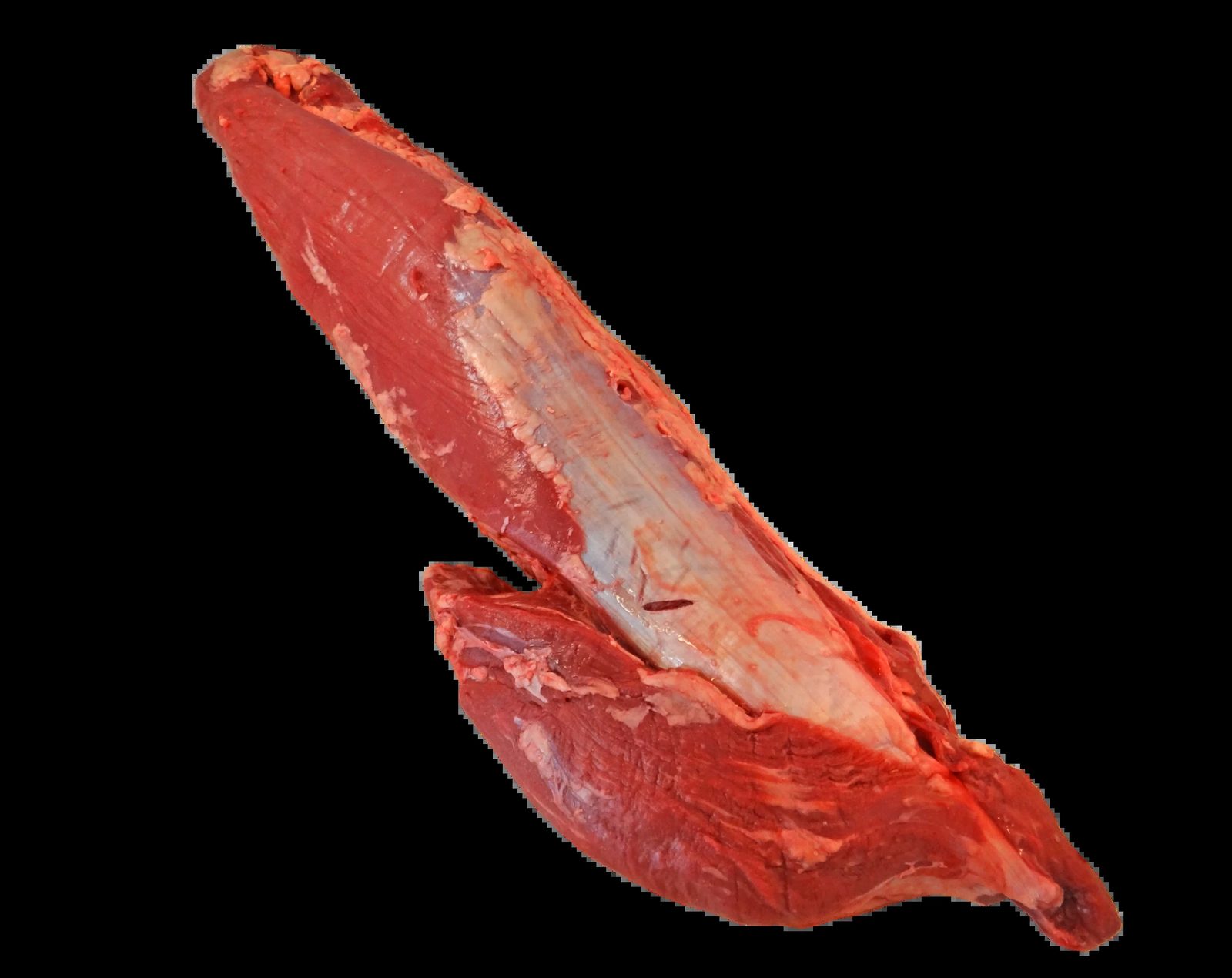
Sirloin. The sirloin lies between the short loin and the round and holds part of the backbone and hipbone. Its roasts and steaks, with or without bone, are tender and flavorful, though not as tender as the strip loin, and are cooked by dry heat. Sirloin comes as top and bottom sirloin; the bottom is often ground, or cut into chunks to stew or braise.
Flank. The flank, under the loin, has no bones. It is flavorful but not tender, with plenty of fat and connective tissue, so most of it is trimmed and ground. Two pieces are kept: the flank steak, also sold as London broil, and the hanging tenderloin, which is not really part of the tenderloin but is very tender and can be cooked any way.
Round. The round is the hind leg. It can weigh up to 200 pounds (90 kg). Its subprimals are the top round, the knuckle, the shank, and the outside round and eye round, which together are called the bottom round. Steaks from the round are less tender. Because the top round and knuckle have large muscles with little fat between them, they roast well. Braising suits the bottom round best, and the hind shank is cooked like the fore shank.
When buying bottom round, look for:
- a short, thick piece with some fat on it;
- bright cherry-red meat;
- flecks of fat through the muscle;
- a firm feel.
Long, lean pieces tend to be tougher and less tasty.
Buyers order beef by number from a standard list, the IMPS numbers: 189 for a tenderloin, for example, 180 for a strip loin and 120 for a brisket.
Trimming and butterflying
Many kitchens buy beef already cut, but a cook still needs to be able to break it down. To trim a whole tenderloin:
- Pull and cut away the loose fat to uncover the meat.
- Take off the chain muscle that runs along one side. It is full of connective tissue, but trimmed, its meat can be used in other dishes.
- Remove the silverskin, the thin, shiny membrane. Lift a corner, hold it tight, and slide the knife along under it in long strips, with the blade tilted slightly up toward the skin so no meat is lost.
- Portion it into chateaubriand, filet mignon, tournedos and tips.
To butterfly a boneless steak, make a first cut almost all the way through, leaving about ¼ inch (6 mm) joined. Then cut right through to free the steak. It opens out thinner and wider, and cooks faster.
Chicken thighs carry more fat than lean beef cuts such as eye round, top round, top sirloin or a shoulder pot roast. Trim off as much outside fat as you can before cooking and serving.
11.4 Veal
Veal comes from calves. It is more delicate in taste than beef, with a finer texture and a paler color, and it has less marbling. Trimmed of visible fat, it is lower in fat and calories than similar beef cuts and leaner than a good many pork and poultry cuts. Its mild flavor goes with many sauces without being overpowered, and it suits nearly every method: dry heat, moist heat or a combination of the two. Quality differs a great deal from one supplier to another, so buy only from reputable companies.
The veal carcass
A veal carcass weighs between 60 pounds (27 kg) and 245 pounds (110 kg). It may be halved along the backbone, but it is more often divided between the 11th and 12th ribs: the front part is the foresaddle and the rear the hindsaddle. It gives five primal cuts. The shoulder, the rib and the loin are cut across the animal, so each holds both sides.
| Primal cut | Saddle | Share of carcass | Best use |
|---|---|---|---|
| Shoulder | Fore | 21% | Braised or stewed; ground or cubed for stew |
| Foreshank and breast | Fore | about 16% | Breast in stews or rolled and stuffed; shank braised |
| Rib (hotel rack) | Fore | about 9% | Roasted, or cut into chops |
| Loin | Hind | about 10% | Dry heat |
| Leg (with the sirloin) | Hind | about 42% | Cutlets and scallops; roasted whole |
The foresaddle
The shoulder matches the beef chuck but holds four ribs instead of five. Boned, it can be roasted, plain or stuffed. Shoulder chops and steaks can be cut, but they are poorer than loin or rib chops. With so much connective tissue, shoulder meat is best braised or stewed, and it is often ground or cubed for stew.
The foreshank and breast count as one primal. The breast goes into stews such as veal fricassee and blanquette. It can also be stuffed and rolled, or trimmed for grinding. The foreshank is tough but full of flavor. Braise it whole, or slice it across the bone and braise the slices to make osso buco.
The rib, sold as a double rib or hotel rack, is small, tender, popular and costly. It is two racks of seven ribs each. Roast it whole or split, bone it into a rib eye and a short tenderloin, both fine roasts, or, most often, cut it into chops to grill, sauté or braise.
The hindsaddle
The loin holds ribs 12 and 13, with the loin eye on top of the bones and the tenderloin beneath. The tenderloin is the most tender cut of veal. If the loin is cut from the leg before the tenderloin comes out, the tenderloin is split in two: the short tenderloin stays with the loin and the butt end with the leg. It may be cut into medallions, and the loin into chops, bone-in or boneless. Loin cuts are cooked by dry heat: broiled, grilled, roasted or sautéed.
The leg includes the sirloin. It is tender enough to roast whole, but it is usually made into cutlets and scallops (escalopes). The leg is first separated into its main muscles. Each muscle is trimmed of all fat and visible connective tissue, sliced across the grain to the thickness wanted, then pounded gently. Pounding makes the scallops more tender and stops them curling in the pan. The hindshank is meatier than the foreshank and is cooked the same way. Wiener schnitzel and blanquette are two classic veal dishes.
Buying veal in larger pieces
A veal carcass is small enough to handle easily, so a kitchen with the skill, equipment and storage, and a use for every trimming, may buy it in large pieces.
- Foresaddle: the front of the carcass, holding the shoulder, foreshank and breast, and rib.
- Hindsaddle: the rear, holding the loin and leg.
- Back: the trimmed rib and loin in one piece, useful for cutting many chops.
- Side: one half of the carcass, cut lengthwise through the backbone.
Veal organ meats, such as sweetbreads, calves' liver and kidneys, are described with the other variety meats below.
11.5 Pork: cuts, butchering and cooking
Pork is the meat of hogs. It comes from young animals, about 6 to 7 months old. A large part of every hog becomes ham, bacon or sausage by curing; meat that is not cured is called fresh pork. Pork gives protein and B vitamins, but it is high in fat, much of it saturated, though breeding and feeding have lowered it. The tenderloin and boneless loin chops count as lean meats. Bacon, ham and sausage are high in sodium.
The primal cuts
A hog carcass weighs about 120 to 210 pounds and is split down the backbone into two sides. Each side is cut into five primals: the shoulder, the Boston butt, the loin, the belly and the fresh ham. Hogs are bred for long loins, the best and dearest meat. Unlike beef, veal and lamb, the ribs and loin of a hog form a single primal. Shop labels in the United States group pork into four larger retail cuts instead: shoulder, loin, side and leg.
| Primal cut | Share of carcass | Cuts it gives | How it is cooked |
|---|---|---|---|
| Shoulder (picnic) | about 20% | Picnic shoulder, shoulder butt steaks, hock | Any method; whole for barbecue; hock simmered |
| Boston butt | about 7% | Boston butt (pork butt) roasts, steaks and chops | Roasted, broiled or sautéed; smoked |
| Belly | about 16% | Spareribs, pork belly, bacon | Ribs simmered or steamed, then grilled; belly cured and smoked |
| Loin | about 20% | Pork loin, chops, tenderloin, back ribs, Canadian bacon | Roasted, sautéed or braised |
| Fresh ham (leg) | about 24% | Fresh ham, ham (cured or smoked), hock | Roasted; almost any method |
Shoulder. The primal shoulder, called the picnic shoulder, is the lower part of the foreleg. It has the arm and shank bones and a lot of bone for its meat. Every hog is young, so even the shoulder is tender enough for any method, though it is one of the tougher pork cuts. It is cheap, and sold fresh or smoked. Bought fresh, it may be sliced into shoulder butt steaks, or boned and diced for sautéing or stewing. Barbecue pit masters across the American South prefer a whole shoulder. The front shank, the shoulder hock, is usually smoked and simmered for a long time in soups, stews and braises to add flavor.
Boston butt. This square cut sits just above the shoulder. It is meaty and tender, with a good amount of fat, and has only a small piece of the blade bone, so it is the cut to use when a recipe wants a solid piece of pork. It can be cut into steaks or chops to broil or sauté. Smoked and boned, it is called a cottage ham.
Belly. The belly lies below the loin. It is mostly fat, streaked with lean. The spareribs always come off before cooking. They are usually sold fresh. They are simmered first, then finished on the grill or in the oven, basted with spicy barbecue sauce. The rest of the belly is almost always cured and smoked into bacon.
Loin. The loin runs from behind the Boston butt and takes in the whole rib section, the loin and part of the sirloin. It is the only pork primal not usually cured or smoked. Most of it is one tender eye muscle. Lean as it is, it has enough fat to braise well, and it can also be roasted or sautéed. The tenderloin, inside the ribs at the sirloin end, is the most tender cut of pork. Trim it and cut it into medallions to sauté, or roast or braise it whole. The most popular loin cut is the chop. The best are center-cut chops, taken after the blade and sirloin ends are removed. A boneless loin is smoked to make Canadian bacon, and the rib bones trimmed off the loin are barbecued as back ribs. Fatback, the thick layer of fat between the skin and the eye muscle, can be more than an inch (2.5 cm) thick and is used in charcuterie.
Fresh ham. The fresh ham is the hind leg, with large muscles and little connective tissue. Fresh, it makes a fine roast and can be cooked almost any way. Most hams are cured and smoked, and come bone-in, shankless or boneless, partly or fully cooked, or canned. The shank end, the ham hock, is used like the shoulder hock.
Very young, small whole pigs, called suckling pigs, are roasted or barbecued whole. Apart from them, kitchens rarely buy pork in pieces larger than the primals.
Butchering pork
To bone a pork loin:
- Start at the sirloin end. Take out the tenderloin in one piece, with smooth cuts along the inside of the rib bones, pulling it gently as you go.
- Turn the loin over and work the knife between the eye meat and the ribs, following the shape of the bones, until the meat comes free.
- Cut around the blade bone at the shoulder end and remove it.
A boned loin is tied into a roast with a single string, looped around the meat at even spaces about 1 inch (2.5 cm) apart and pulled snug along its length. The strings should hold the shape without cutting into the meat.
A center-cut chop can be cut from a bone-in loin without a saw.
- Trim the outside fat, leaving a ¼-inch (6 mm) layer to protect the meat as it cooks.
- Cut through the meat with a boning knife.
- Chop through the chine bone (the backbone) with a heavy cleaver.
- For a neater chop, clean the meat off the end of the rib bone and cut the chine away.
Grades, buying and safety
USDA inspection of pork is required; grading is voluntary and has only two levels. Acceptable is the only grade of fresh pork sold in shops; Utility goes into processed products. When buying, look for a small amount of outside fat, firm grayish-pink meat, and a little marbling for flavor and tenderness.
Pork must be cooked through to destroy parasites and bacteria. Eating undercooked pork can cause trichinosis, a disease from a parasite, though cases have dropped a great deal since 1950. Medium-well pork reaches between 65°C and 69°C (150°F and 158°F) inside and well-done pork 71°C (160°F), and ground meat must reach 70°C (158°F). Organ meats are cooked to 160°F. Pork cooked to a safe temperature can still be pink in the center.
Individual cuts of meat are used within two days, best on the day they are cut. Liver and other variety meats are used within 1 to 2 days. Frozen roasts, steaks and chops keep their best quality for 4 to 6 months. Marinate pork covered, in the refrigerator. Boil a used marinade before brushing it on cooked meat, and throw away any that is left uncooked.
Some starting times for roasting pork, with the oven at 350°F unless noted:
- Loin roast, 2 to 5 pounds: about 20 minutes a pound.
- Boston butt: about 45 minutes a pound.
- Tenderloin: hotter, at 425°F to 450°F, for 20 to 27 minutes in total.
- Ribs: 1½ to 2 hours, or until fork-tender.
Always check with a thermometer. Dry heat, braising and stewing are taught earlier. see chapter 8: What roasting is see chapter 10: Slow and low: braise, stew, sous vide
11.6 Lamb
▶ LectureLamb is the meat of sheep killed before they are a year old. Meat from older sheep is mutton. Because it is young, lamb is tender enough for almost any method. It has a strong, distinctive taste and stands up to bold sauces and garnishes. Most lambs are sold for meat at 6 to 8 months old.
"Spring lamb" has two meanings. It can mean young lamb never fed grass or grain. On a label, it tells you the lamb was killed some time from March to October.
The primal cuts
▶ LectureA lamb carcass weighs 41 to 75 pounds (20 to 35 kg). It is cut into five primals: the shoulder, the breast, the rack, the loin and the leg. As with some veal primals, each is cut straight across the animal, so it holds both sides; the primal leg holds both hind legs.
| Primal cut | Share of carcass | Cuts it gives | How it is cooked |
|---|---|---|---|
| Shoulder | 36% | Shoulder roast, chops, stew meat, ground lamb | Braised or roasted boned; mostly diced for stew or ground |
| Breast (with foreshank) | about 17% | Breast, Denver ribs, shank | Stuffed and braised; shanks braised |
| Rack (hotel rack) | about 8% | Rack, rib chops | Grilled, broiled or roasted |
| Loin | about 13% | Loin roast, chops, noisettes | Dry heat |
| Leg (with the sirloin) | about 34% | Leg bone-in or boneless, leg steaks | Roasted or braised |
Shoulder. The shoulder holds four ribs, the arm, blade and neck bones, and many small, tough muscles running different ways. That makes a whole shoulder almost impossible to cook and carve. It can be cut into chops, or boned and roasted or braised, stuffed or not, but most often it is diced for stew or ground for patties.
Breast. The breast takes in the foreshank. Trimming the rack leaves behind the rib tips, which belong to the breast. Cut away on their own, these little ribs are sold as Denver ribs and can replace pork ribs. The breast can be stuffed and braised, with or without its bones. Foreshanks are meaty; braise them as a main course, or use them for broth or grinding.
Rack. The rack, or hotel rack, sits between the shoulder and the loin and is prized for its tender rib eye. It holds eight ribs, or nine as some count it. The rack is usually split in two. Each half is grilled, broiled or roasted whole, or first divided into rib chops, one or two bones thick. Two rib roasts sewn into a circle make a crown roast.
Loin. The loin holds the 13th rib, the loin eye, the tenderloin and the flank. Apart from the flank, it is very tender and is always cooked by dry heat: broiled, grilled or roasted. It can be boned for roasts or boneless chops, or cut into bone-in chops, and the eye can be cut into medallions, called noisettes.
Leg. The leg includes the part that would be the sirloin on beef. It is rarely used whole; it is split into two legs and partly or fully boned. The sirloin end is more tender than the shank end. Bone-in legs are roasted for buffets or braised with vegetables or beans. Steaks can be cut from it, the most tender from the sirloin end. A boned leg can be tied and roasted, stuffed or plain, or cut into scallops, and the shank end diced for stew or ground.
Lamb chops come from several primals. Loin chops and rib chops are the most tender and the most expensive. Cheaper chops, which may be just as tender, are the sirloin chop from the leg and the blade and arm chops from the shoulder.
Buying lamb
Lamb is small enough to handle as a whole carcass, so some kitchens buy it whole and cut it themselves. That only pays if the kitchen has the skill, the equipment and the storage, and a use for every cut and trimming. Besides whole carcasses, primals and smaller cuts, suppliers sell:
- Foresaddle: the front, cut off between the 12th and 13th ribs, with the shoulder, breast, foreshank and rack.
- Hindsaddle: the rear, with the loin, the leg and the kidneys.
- Back: the rack and loin together, trimmed, handy for cutting many chops.
- Bracelet: the hotel rack with the breast still joined to it.
Nearly half the lamb sold in the United States comes from New Zealand and Australia. Lamb raised in the United States is mostly fed grain and tastes milder than grass-fed lamb. It is raised to about 135 pounds, bigger than imported lamb, so its cuts are bigger. Choose lamb that is fine-grained and firm, red with white marbling, with firm white fat that is not too thick. USDA-graded lamb in shops is Prime, Choice or Good, and most of it is Choice.
Compared with other red meats, lamb is lean and has less cholesterol, and a good source of iron compared with chicken or fish. Its extra fat sits on the outside of the cut, where it is easy to trim.
Frenching a rack
Frenching cleans the meat off the rib bones for a neat look.
- With a meat saw, cut the ribs to about 3 inches (7.5 cm), measured from the eye of meat.
- Flip the rack and free the meat from the featherbones by cutting along each side of them.
- Turn it back. With the saw held at 45 degrees, cut through where the ribs meet the chine bone.
Handling and cooking lamb
Raw lamb does not need rinsing. Rinsing spreads germs around the sink and is not needed, since cooking kills any bacteria. Individual cuts of meat are used within two days, best on the day they are cut. Ground lamb and stew meat keep 1 to 2 days. Frozen roasts, steaks and chops are best within 6 to 9 months, ground lamb within 3 to 4. Marinate roasts, steaks and chops in the refrigerator for up to 5 days, and cubes or stew meat for up to 2 days.
Medium-well lamb reaches between 65°C and 69°C (150°F and 158°F) inside and well-done lamb 71°C (160°F), and ground meat must reach 70°C (158°F). Organ meats are cooked to 160°F. A bone-in leg roasts at 325°F for about 20 to 25 minutes a pound. Shanks and stew meat need 1½ to 2 hours of braising.
Plan for loss in the oven. After cooking, a pound of raw bone-in leg or roast gives 8 to 9 ounces of meat to eat. Ground lamb or a boneless cut gives about 10.5 ounces.
11.7 Game
Game means wild animals and birds. Farm-raised game is a wild species now raised on farms for sale. In the United States, states require restaurants to serve only game that was slaughtered and dressed under inspection. Game raised on farms under the proper rules can be sold. Wild game that is legally hunted cannot be sold; it may only be eaten by the hunter's own household. Suppliers who are not approved sometimes sell poached game; buy only from approved sources.
Game animals
Large game in North America includes deer, elk, moose, caribou, reindeer, antelope, bison, bear and wild boar. Small game includes rabbit, squirrel and alligator, among others. On a menu, venison can mean the meat of deer, elk, moose, caribou, antelope or pronghorn, but meat sold as venison must name the animal on its label.
- Deer meat is lean and tastes gamey. Soaking it overnight makes the taste milder.
- Elk tastes like a mild beef, almost sweet, with just a hint of venison, and can replace venison in most recipes.
- Moose is the largest of the venison animals, and its meat is like elk.
- Caribou (reindeer) is a little sweeter than other venison.
- Antelope and pronghorn are leaner than deer but taste much the same.
- Bison (buffalo) is said to taste sweeter and richer than beef. Hunted almost to extinction by the 1890s, it is now raised on farms across North America, more than 150,000 animals.
- Musk-ox tastes like bison. For collared peccary (javelina), fresh pork is the substitute.
- Rabbits sold for food in the United States are not North American cottontails. They are usually crosses of New Zealand and Belgian rabbits, Chinese rabbits, or Scottish hares.
- Wild boar and feral hogs are not native to North America. Most states treat them as pests and encourage hunting them.
Game birds
Game birds include grouse, guinea fowl, partridge, squab, quail, pheasant, ratites, wild ducks, wild geese and wild turkey. Rock Cornish hens, often thought of as game, are young farm chickens.
- Pheasant: the hen, about 3 pounds, is more tender, plump and juicy than the cock, about 5 pounds. Roast young birds; older birds are drier and leaner and need moist heat.
- Quail: about 3 to 7 ounces ready to cook. Its meat is dark but mild, and it is usually roasted and served whole.
- Squab: a pigeon about 4 weeks old, too young to fly, so its meat is very tender. It weighs 12 to 16 ounces and is usually stuffed whole and roasted.
- Guinea fowl: tender when young, at about 11 weeks; hens are more tender than males. The meat is light red, a little dry and mildly gamey. At 2 to 3 pounds it is sold whole, and barding with fat keeps it moist.
- Wild duck: a duckling, usually under 8 weeks, weighs about 3½ to 5 pounds and its dark meat is tender. A duck over 6 months is tougher.
- Goose: 5 to 18 pounds. A young goose is tender, a mature one tougher.
- Wild turkey: leaner, less meaty, less tender and stronger-tasting than a farm turkey.
- Ratites (ostrich, emu, rhea): the meat looks like beef and tastes like it, a little sweeter.
How game differs from farm meat
Wild animals eat differently and move more than farm animals, so farm-raised game tastes stronger than farm meat but milder than wild game. Quality depends on the animal's age (young is tender), its diet and the season it was taken; autumn is best, after a summer of good feeding. Handling in the field matters as much. The animal should be gutted within an hour and the meat chilled within a few hours. Meat that is not dressed, moved and chilled properly is damaged, sometimes ruined.
Wild game is usually less tender than farm meat, because the animals exercise more and carry less fat. What fat there is usually tastes bad, so trim it off. For the most tender result, cook game slowly and do not overcook it. Braising (moist heat) and roasting (dry heat) both work. Keep it moist by basting, by larding (threading fat into the meat) or by barding (covering it with fat). see chapter 10: Why it works on tough meat
To soften a strong gamey taste, soak the meat overnight in the refrigerator in salted water (1 tablespoon of salt to a quart of cold water) or in diluted vinegar (1 cup to a quart of cold water). Cover the meat completely, and throw the liquid away after. A marinade also adds flavor or tenderizes. Keep the meat in the refrigerator while it marinates: birds for 1 to 2 days, game animals for 3 to 5. Bring a used marinade to the boil before you baste with it, and throw out any left uncooked.
Safety
Raw or undercooked game can carry harmful bacteria such as Salmonella and E. coli O157:H7, which is found in deer. Freezing does not kill bacteria; cooking does. Poultry must reach 74°C (165°F) for 15 seconds, ground meat 70°C (158°F), and well-done meat 71°C (160°F). Take the reading of a whole game bird in the thigh, in the wing and where the breast is thickest, and cook other cuts of game to 160°F.
Individual cuts of meat are used within two days, and fresh poultry is kept packed in ice. Game birds and ground game should be cooked or frozen within 1 or 2 days of purchase. Thaw game in the refrigerator, in cold water or in the microwave, never on the counter.
11.8 Offal and variety meats
Offal falls into two groups. Muscular offal, such as heart, tongue, tripe and oxtail, is muscle. Glandular offal, such as liver, kidney and sweetbreads, is gland. Like all meat, offal is a potentially hazardous food.
| Animal | Common offal | Notes |
|---|---|---|
| Beef | Heart, liver, kidney, tongue, tripe, oxtail | Beef offal is the kind shops sell most |
| Veal | Heart, liver, kidney, tongue, brains, sweetbreads | Veal offal is the kind restaurants serve most |
| Pork | Liver, heart, kidney, intestines, skin, blood | Strong flavor; liver for pâté; skin for cracklings; blood for blood sausage |
| Lamb | Liver, heart, kidney, tongue, intestines | Milder flavor; intestines as casings for small sausages |
| Chicken | Heart, liver, gizzard, feet | Heart, liver and gizzard are the giblets |
| Duck and goose | Liver (foie gras) | Fattened livers, used in sweet and savory dishes |
Liver
Liver is very fine in texture and has almost none of the fiber bundles found in red meat. It has no grain, so it is tender and you can slice it whichever way you like. Calf's liver is the favorite and is often sautéed with onions. Pork liver tastes stronger and goes mostly into pâté; lamb liver is milder.
Before cooking sliced liver, peel off any membrane and snip out the veins with scissors. For crisp fried liver:
- Cut the slices into strips 1 to 1½ inches wide.
- Sprinkle them with lemon juice.
- Coat them in seasoned flour, then in milk and egg, then in cracker crumbs.
- Fry in hot oil for 3 to 4 minutes a side.
Chicken livers cook quickly. Sautéed, they firm up in about 6 minutes, and can then be puréed with butter and cream and chilled into a smooth pâté. For chicken liver stroganoff, they are sautéed, covered, over low heat for about 5 minutes, then warmed with sour cream; do not let the sauce curdle.
Kidney, heart and tongue
Lamb and pork kidneys are smooth and bean-shaped. Beef kidneys are lumpy, with reddish-brown lobes and deep clefts, and are very tough; they need long, moist cooking. Kidney pie is a well-known European dish.
Heart is sold whole, halved or sliced. Inside it are string-like sinews; take them out if you will stuff it. Heart can be cooked by dry heat: stuffed and roasted whole, or sliced, seasoned and pan-fried. Anticuchos are pieces of beef heart grilled on a skewer.
Tongue has a coarse skin that only comes off after long, slow simmering, six to eight hours. Once skinned, it slices well and is quite tender, and its gelatin gives it a rich taste. Before cooking, it is often corned or pickled. Braised like a pot roast, it is the lengua of Latin tacos.
Tripe, sweetbreads and brains
Tripe comes from the stomach: it is the muscular lining inside. It is smooth or honeycombed, depending on which part of the stomach it comes from, and is sold fresh or pickled. Washed or dressed tripe has been boiled and bleached, which is why tripe in shops is usually white. Only moist heat breaks down its rubbery texture, so it goes mostly into soups and stews.
Sweetbreads are the thymus glands. They are pinkish white, and those from calves are a great delicacy. A calf's sweetbreads reach their biggest at five to six weeks of age, then shrink as it grows older. Soak them well in cold water, then blanch them so the outer membrane can be peeled off. Then braise them, or chill, slice, bread and pan-fry them.
Brains spoil very fast, so they are usually frozen at the processing plant right after removal. They are mild and delicate, are cooked like sweetbreads, and are very high in cholesterol. Calves' brains are the ones most used.
Oxtail, cheeks and caul fat
Oxtail counts as offal although it is not an organ. It is more bone than meat. It is used mostly for soup, and once properly braised its meat is very rich. Beef and veal cheeks are not strictly offal but are growing in popularity. Pigs' heads make headcheese, meat from the head set in jelly made from its cooking liquid.
Caul fat is the thin, lacy sheet of fat that covers a hog's stomach. It is used to wrap lean meat, fillings and sausage meat. Braising, the usual method for the tough offal, is taught earlier. see chapter 10: Why it works on tough meat
11.9 Cooking poultry
Chicken recipes → Turkey recipes → Duck recipes →
Cutting a chicken into ten pieces
Poultry cookery begins with disjointing: cutting the bird into halves, quarters and single portions. This method gives ten pieces:
- Lay the chicken on its back on a surface that is easy to clean. Pull a leg outward from the body. Slice through the skin, then between the muscles, heading for the hip joint.
- Cut through the joint, then cut the muscle and skin away close to the body. On an older, less tender bird, such as a stewing hen for fricassee, you may need to snap the joint by hand. Repeat on the other side.
- Bend the thigh and drumstick together to find the joint, and cut through it.
- Pull each wing out to find its joint, and cut through it.
- Find where the back ribs meet the front ribs. Cut through the skin and ribs on each side, from the tail toward the neck, then bend the breast back to break it from the back and cut the two apart.
- Cut the back across into two pieces, and the breast into two, lengthwise or across.
- Check every piece to make sure the bird was fully cleaned inside, and remove the kidneys if they are still there.
The safe temperature
Poultry must reach 74°C (165°F) inside and hold it for 15 seconds. Juices that run clear are a sign of doneness. Do not rely on time alone; check the inside with a thermometer.
For broiled, grilled and roasted birds, aim a little higher: 165°F to 170°F (74°C to 77°C) at the coolest point, read in the thickest part and away from the bone. The other signs of doneness, loose joints and clear juices, are set out with inspection and storage above.
Matching the method to the bird
Young, tender birds suit dry heat. Older, tougher ones need moist heat. Each kind of bird brings its own problem to the oven or grill.
- A large bird such as a turkey cooks best at low heat, yet its skin only crisps at a higher one.
- Duck and goose skin holds a lot of fat, which has to be rendered out as the bird cooks.
- Small birds such as squab need heat high enough to crisp the skin, but they overcook in moments.
- A boneless chicken breast has no bone to help hold in its moisture, so it dries out quickly, above all on the grill or under the broiler.
Chicken five ways, side by side
- Broiled. Brush the pieces with melted butter and lemon juice and lay them skin side down on the broiler pan. Turn and baste them every 5 to 10 minutes. They take about 10 to 20 minutes.
- Oven-baked. Coat the pieces in flour seasoned with salt, paprika and pepper, roll them in melted butter, and bake skin side down, uncovered, at 350°F for 30 minutes. Turn them and bake 15 to 20 minutes more.
- Fried. Shake the pieces in a bag of seasoned flour, two at a time, and let the coating dry on a rack. Heat about ¼ inch of oil until a drop of water sizzles in it. Brown the meatiest pieces first, then the small ones, and do not crowd the pan. Brown both sides, turning with tongs, then finish in a 350°F oven for about 10 to 20 minutes.
- Roasted. For a Cornish game hen, check that the lungs and kidneys are gone from the cavity, rub the skin with melted butter and set the bird breast up on a rack. Put a thermometer in the middle of the inner thigh. Roast it at 350°F for about an hour, and baste it with drippings or melted butter every 30 minutes.
- Microwaved. Set chicken thighs skin side up in a covered dish with a sauce, thickest parts toward the outside. On medium-high power they take about 9 to 11 minutes.
The bread dressing for the hen bakes separately, covered, for 45 minutes at 350°F, rather than inside the bird. Serve dressing within a few minutes of taking it from the oven; do not leave it standing at room temperature. Stuffing cooked inside poultry must reach 74°C (165°F). Microwaving is covered earlier. see chapter 7: Microwaving
Broiling and grilling
How the grill and broiler work is taught earlier. see chapter 8: Fitting the method to the food
Broiled or grilled poultry should be well browned outside, perhaps with crosshatched grill marks, and moist and juicy inside. Small birds suit these methods best: Cornish hens, chickens and squab. Split a whole bird or cut it into pieces, and break the joints so it lies flat. Thread quail and other tiny birds on skewers so they keep their shape and cook evenly. Watch breasts and boneless pieces closely, because direct heat overcooks them fast.
Poultry tastes fairly neutral, so it takes well to a marinade, or to basting during cooking with a flavored butter, an oil or a barbecue sauce. At the least, season it with salt and pepper just before it goes on. Duck breast and squab are sometimes served pink; all other grilled poultry is cooked well done. Because poultry is lean and the heat is fierce, it dries out and toughens easily, so take care not to overcook it.
- Heat the grill or broiler. Scrub the grate with a wire brush, then wipe it with a lightly oiled cloth to clean and season it.
- Marinate or season the poultry, and brush it lightly with oil so it does not stick.
- Turn it to mark it with a crosshatch, and baste it often. Turn it with tongs so the surface is not pierced and the juices stay in.
- Move the pieces on the grate, or change their distance from the heat, to get good color while they cook through. Large or bone-in pieces that will not cook through on the grill can be finished in the oven.
For large batches, lay the seasoned pieces in a shallow pan and slide it under the broiler. Baste now and then, turn them once halfway, and move the whole pan to the oven to finish. Serve grilled poultry with more of the butter or sauce it was basted with. Any marinade or sauce that touched the raw bird must be cooked thoroughly before it is served.
Roasting
Roasting itself, and carryover cooking, are taught earlier. see chapter 8: What roasting is
Almost every bird can be roasted, though young ones give the most tender result. Roasted poultry should be browned and crisp outside, tender and juicy within. Most roast birds are done when their juices run clear, though squab and duck breast are often served pink. Roasted poultry is usually seasoned lightly, with salt and pepper. Never put herbs on the skin of a bird roasted at high heat, because they burn. Put herbs and spices in the cavity instead, along with a mirepoix or a bouquet garni if you like. Ducks and geese are often filled with fresh or dried fruit.
Trussing means tying a bird into a compact shape with butcher's twine. A trussed bird cooks more evenly, stays moister and looks better. Some methods use a trussing needle; the steps below need none.
- Press the bird firmly into an even shape. Fold the first wing joint back under the bird, or cut off the first two wing joints.
- Cut twine about three times the length of the bird. Lay the bird breast up, neck toward you, and slide the twine beneath it about 1 inch (2.5 cm) in front of the tail.
- Bring both ends up around the legs, cross them to make an X between the legs, and pass them under the legs.
- Pull the ends tight across the leg and thigh joints, then across the wings if they were trimmed, or just above them if not.
- Pull it tight and tie it firmly above the neck.
Barding protects a bird with too little fat of its own, such as a guinea, a squab or a skinned bird. Cover it all over with thin slices of fatback and tie them on with twine.
Each kind of bird roasts at its own temperature, because their fat content differs.
| Bird | Temperature | Other temperature given, with time |
|---|---|---|
| Squab | 375°F to 400°F (190°C to 200°C) | 400°F (200°C); 30 to 40 minutes in all |
| Cornish game hen | 375°F to 400°F (190°C to 200°C) | 375°F to 400°F (190°C to 200°C); 45 to 60 minutes in all |
| Chicken | 350°F to 375°F (180°C to 190°C) | 375°F to 400°F (190°C to 200°C); 15 to 18 minutes a pound |
| Guinea | not given | 375°F to 400°F (190°C to 200°C); 18 to 20 minutes a pound |
| Capon | start at 400°F to 425°F (200°C to 220°C), finish at 275°F to 325°F | 350°F to 375°F (180°C to 190°C); 18 to 20 minutes a pound |
| Turkey | start at 400°F to 425°F (200°C to 220°C), finish at 275°F to 325°F | 325°F (160°C); 12 to 15 minutes a pound |
| Duck, goose | 375°F to 425°F (190°C to 220°C) | 375°F to 425°F (190°C to 220°C); 12 to 15 minutes a pound |
Roasting temperatures and times by bird.
The reasons behind the temperatures in the first column:
- Small birds roast hot so the skin crisps and colors before the flesh overcooks.
- Chicken roasts a little lower, so the skin crisps without the bird stewing in its own juices.
- Capons and turkeys start hot to brown the skin, then finish cooler so they cook evenly and stay moist.
- Ducks and geese need high heat to render the fat from the skin, and their skin is often pricked first so the fat can run out.
A Cornish game hen can also roast at 350°F, for about an hour.
- Season, bard, stuff or truss the bird as the recipe asks.
- Set it in a roasting pan, raised on a rack or on mirepoix, so it cooks evenly and does not scorch.
- Roast it uncovered, basting it every 15 minutes.
- Let it rest before carving so the juices settle, and make the gravy or sauce meanwhile.
Baste every bird except ducks and geese, which are fatty enough already. Spoon the fat from the pan over it every 15 to 20 minutes; a lean bird that is not barded gives too little fat, so brush it with butter instead. A stuffed duck or goose is raised on a rack or on mirepoix, so the fat that gathers in the pan cannot soak into the stuffing. Large birds keep cooking a little after they leave the oven, but this matters less with poultry than with meat, because a large bird is always cooked well done.
Bread stuffing and gravy are the usual partners for a roast bird. A capon or turkey gives enough drippings to make gravy in the pan. Squab, game hens and other small birds often get a wild rice stuffing and a sauce made on its own. Ducks and geese go well with a sauce of citrus or other fruit, whose acid balances the fat.
Let a roast turkey stand for 20 minutes, and a roast chicken for 15, before carving. To carve, cut through the hip joint to free each leg and thigh together, keeping the oyster, the tender nugget of meat beside the backbone, on the thigh. Then cut the breast away from the ribs, following the bones, and slice it at an angle for larger slices.
Poêléing
A poêlé sits between roasting and braising. The bird cooks in the oven in a covered pot, in its own juices and steam. That makes it a moist-heat method, but it is used only for tender birds, not ones that need long braising, and it takes less time than an open roast. The bird lies on a bed of matignon: onion or leek, celery and carrot, minced fine with thyme and bay leaf and cooked gently in butter until soft but not brown, then finished with a little white wine or Madeira.
- Sear the bird in hot butter or oil, if you want it browned.
- Lay it on the matignon, with any other vegetables the recipe calls for.
- Cover the pot and cook it in the oven until done, basting now and then with the pan juices or more butter.
- If it was not seared first, take off the lid near the end so it can brown.
- Lift out the bird. Add a liquid such as stock, jus lié or demi-glace to the juices and matignon, and reduce it into a sauce. Strain out the matignon or leave it in.
Check doneness the same way as for a roast. Braising, the slower relative of this method, is taught earlier. see chapter 10: What braising is
Sautéing
Sautéing is taught earlier. see chapter 8: Sauté and pan-frying
Most poultry is tender enough to sauté. Small birds such as squab can go in on the bone, but large bone-in pieces from big birds should not. The best cuts are boneless breasts, supremes, scallops and cutlets. A boneless duck breast is fatty enough to sauté with no added fat. Stir-frying is a kind of sauté: boneless strips cooked fast with vegetables and seasonings. If the pieces are dusted with flour first, the seasoning can go into the flour.
Heat the pan and the fat before the poultry goes in. A thin boneless slice needs high heat, so the outside browns before the middle overcooks. A thick piece such as a supreme needs lower heat, so neither it nor the fond (the browned bits in the pan) burns before it is cooked through. Never let the pan cool; a crowded or cool pan leaves the poultry stewing in its juices and soaking up oil.
Thin cuts cook so fast that timing works as a guide. For thicker ones, press the meat with a finger:
- very undercooked poultry feels mushy and barely resists;
- slightly underdone poultry feels spongy and does not spring back;
- properly cooked poultry feels firm and springs back;
- overcooked poultry feels very firm, almost hard, and springs back quickly.
Put the presentation side down first and brown it, then turn the piece with tongs or a toss of the pan. Larger pieces can finish in the oven, either in the same pan or moved to another, which frees the first pan for the sauce. For the sauce:
- Pour off most of the fat.
- Sauté garnishes such as garlic, shallots and mushrooms.
- Deglaze with wine or stock, and scrape up the fond.
- Reduce.
Serve with pasta, rice or potatoes.
Pan-frying and deep-frying
Frying, in shallow and deep fat, is taught earlier. see chapter 8: How much fat
Fried chicken is the best-known pan-fried poultry; young birds cut into small pieces work best. Boneless chicken breasts and turkey scallops are pan-fried too. The pieces are floured, breaded or battered, and the seasoning usually goes into the coating. A good result is juicy inside, with a crisp, golden coating that is not greasy and has no gaps for fat to get in.
Use enough fat to come a quarter to halfway up the pieces, at about 325°F (160°C), a little cooler than for sautéing. It must sizzle when the poultry goes in. Thin pieces cook hotter and faster; thick and bone-in pieces cooler and longer. Turn each piece when the first side has good color, by which point it should be about half cooked. Drain the pieces on absorbent paper. The pieces are often too small for a thermometer, and pressing them in hot fat is risky, so timing and experience guide the cook. Fried chicken can take 30 to 45 minutes.
Pan-frying leaves no fond for a pan sauce, so serve lemon wedges, a vegetable garnish or a sauce made separately. Fried chicken is the exception: it is sometimes served with country gravy, made from a roux of some of the frying fat with milk. If the fried poultry is warmed in a sauce before serving, leave it there only long enough to heat; never try to cook it in the sauce.
Portioned chicken and whole small birds such as Cornish game hens are the best choices for deep-frying. Season the breading or batter rather than the bird. Heat the fat to about 350°F (177°C): hot enough to cook the inside before the coating burns. Lower the poultry in with the basket, fry until crisp and golden, then hold it over the fryer to drain before moving it to a pan lined with paper or fitted with a rack. Salt it if you like. Hot food held for service is kept at 60°C (140°F) or hotter. A heat lamp keeps deep-fried poultry hot. Cooked chopped poultry can also be bound with a thick béchamel or velouté, breaded and deep-fried as croquettes.
Poaching and simmering
Poaching and simmering are taught earlier. see chapter 9: What poaching is
Poultry is poached or simmered in liquid. Poaching suits tender birds, cooked briefly; simmering suits older, tougher birds, cooked for longer to tenderize them. The two differ mainly in the heat of the liquid and the cooking time. Young birds and boneless chicken pieces are poached. Ducks and geese are seldom poached or simmered, because they are so fatty.
Use a well-flavored liquid: a strong stock with a sachet, or stock or water with white wine and a bouquet garni or onion piquet. Cover the poultry completely so it cooks evenly, but do not drown it in a weak liquid, which draws the flavor out of the meat. Older birds are often simmered in plain water with a sachet and plenty of mirepoix, and the strong broth they make is used in the dish or kept.
The liquid stays within these temperatures:
- Poaching: 160°F to 175°F (71°C to 79°C), for moist, tender meat.
- Simmering: from 185°F (85°C) up to the boil. Never let it boil, or the meat turns dry, tough and stringy.
The poultry itself must reach 74°C (165°F) for 15 seconds. Read it in the thigh or the thickest part; any juices should be clear or only faintly pink.
Serve poached chicken hot with a flavored mayonnaise, or with a sauce such as sauce suprême, made by reducing the poaching liquid. Poaching also makes a low-calorie dish, served with a vegetable coulis or some of its own broth. Cold, the meat goes into salads and other dishes that call for cooked poultry. A simmered bird meant to be served cold stays moister if it cools in its broth. Take the pot off the heat while the bird is still slightly underdone, then cool bird and broth together in an ice bath. Cooked food must drop to 20°C (68°F) within two hours of leaving 60°C (140°F), then to 4°C (40°F) within four more hours.
Braising
Chicken cacciatore shows moist heat on poultry.
- Brown the pieces in hot olive oil for about 10 minutes and set them aside.
- Soften mushrooms, onion and garlic in the drippings for about 5 minutes.
- Return the chicken and pour over a mix of tomatoes, tomato paste, broth and dried herbs.
- Bring it to the boil, then lower the heat, cover and simmer for 30 to 35 minutes, until the chicken is no longer pink.
Braising poultry is taught in full earlier. see chapter 10: Braising poultry
11.10 Sausages and casings
What sausage is
The word sausage comes from the Latin salsus, meaning salted. Sausage making goes back at least to the early Greeks and Romans. Sausage began as a way to keep meat and carry it; people learned that salt preserves meat, and that dried meat could be mixed with dried berries and spices. Stuffing meat into casings is still done much the same way, but recipes have grown far more refined.
A sausage has six basic parts:
- The main ingredient, usually a tough cut from the leg or shoulder.
- Fat, most often pork fat, sometimes heavy cream. Fat is essential: it gives moisture, flavor and a feeling of fullness.
- Seasonings and cures: sugars, salts and curing agents. They help prevent food-borne illness and add flavor, and in hot smoking the sugar helps the sausage brown.
- Spices, toasted or not, whole or ground. Italian sausage, sweet or hot, usually has whole fennel seed; merguez, from North Africa, uses Tunisian spices.
- Herbs, fresh or dried.
- Aromatics: wine, spirits, citrus zest, bottled sauces like hot pepper sauce or Worcestershire, and vegetables, which are often cooked first. Cajun boudin is a sausage of rice and pork, mostly liver, with celery, onion and bell pepper.
The casing is not one of the basic parts, because many sausages are made as patties or sold loose, in bulk. Herbs and garlic can carry microbes from the soil, so cooks often cook them before adding them to raw meat, especially for a sausage that will be cured without cooking.
The French spice mix quatre épices goes into everything from pâté to duck confit. One recipe mixes ground spices in these proportions:
- 2 parts black pepper;
- 1½ parts nutmeg;
- 1 part cinnamon;
- 1 part cloves.
Fresh, cured and smoked
There are two main kinds of sausage, fresh and cured. A cured sausage may be cooked or dried. Smoking is common for cured sausages but not required. Curing changes the meat and its taste, as a ham tastes different from a roast of pork. Every smoked sausage is cured, because of botulism. The germ behind it, Clostridium botulinum, is everywhere, grows without air in the middle of a sausage, and thrives at 4°C to 60°C (39°F to 140°F), the warmth of a smokehouse and of storage afterwards. The range 4°C to 60°C (40°F to 140°F) is the danger zone, where most harmful bacteria grow.
| Kind | Examples | Storage |
|---|---|---|
| Fresh | Fresh pork sausage, bratwurst, bockwurst | Refrigerate; cook thoroughly; use within 3 days or freeze |
| Uncooked smoked | Smoked country-style, mettwurst, kielbasa | Refrigerate; cook thoroughly; use within 7 days or freeze |
| Cooked smoked | Frankfurter, bologna, cotto salami | Refrigerate; use within 7 days of opening the vacuum pack |
| Dry | Genoa salami, pepperoni | Needs no refrigeration |
| Semi-dry | Lebanon bologna, cervelat, summer sausage, Thüringer | Refrigerate for best quality |
| Cooked meat specialties | Loaves, headcheese, scrapple | Refrigerate; use within 3 days of opening the vacuum pack |
Grinding
Get the equipment ready first.
- Safety. Unplug the grinder. Make sure every part is there, in good order, clean, sanitized and free of rust, so no rust or old protein gets into the meat.
- Cold. Chill the housing, worm (auger), blade, die plates and collar in an ice bath. Cold parts keep the fat from melting, which gives a good emulsion. Skip this and the sausage turns mealy and crumbly, ends up dry, and bursts on the grill.
- Care. Do not cut the meat too big for the feed tube, and do not force it down too fast.
To put the grinder together:
- Put the worm into the mounted housing.
- Fit the blade over the end of the worm with its flat side facing out, toward you.
- Add the die, the plate with holes, lined up by its notch.
- Screw the collar on snugly, and only then plug the machine in.
- Chill the meat and fat as close to freezing as you can, 30°F to 32°F, and cut them into 1- to 2-inch pieces that slip easily into the tube.
- Grind. The meat should come out looking like ground beef. If it is torn, or the fat comes out pasty and smooth, the blade may be on backwards. Stop, unplug, and take the grinder apart to find the fault.
- Mix the ground meat in a chilled mixer on medium speed for about a minute to spread the seasoning and fat evenly. Do not overfill the bowl.
- Cook a small piece and taste it before filling any casings. Cook it the way the finished sausage will be cooked: poach a sausage meant for poaching, grill one meant for the grill.
Some recipes mix the cures and seasonings into the diced meat and fat and let it rest before grinding. Others grind the meat and fat separately and season afterwards. Follow the recipe. Tasting and seasoning are covered earlier. see chapter 6: When to add them
Fermented sausages
Dry and semi-dry sausages are an old craft back in demand for charcuterie boards. During their long cure, lactic acid forms and gives them a tangy taste. Summer sausage and Lebanon bologna are semi-dry; saucisson sec, a dry pork and garlic sausage cured in hog middles, is dry.
- Use salt and curing agents (nitrates and nitrites) with sugars such as sucrose and dextrose, at roughly 65 percent meat to fat. The salts keep harmful bacteria away, and the sugars help the cure and feed the helpful bacteria.
- Mix the meat well with the salts and sugars and hold it for a few days as close to freezing as possible, then add the other seasonings and grind.
- Stuff carefully so no air pockets are left, where bacteria could grow. Keep the drying room at about 60 percent humidity, so the inside dries and no green mold grows on the casings.
- Semi-dry sausages lose about 15 percent of their weight as they dry, and dry sausages up to 30 percent. A white mold on the outside is harmless and welcome.
Emulsion sausages
Frankfurters, bologna and mortadella are emulsion sausages: the meat is chopped to a smooth paste. They follow a 5-4-3 ratio. Five parts are trimmed raw meat, four parts pork fat taken from the jowl, the belly or the plate, and three parts water, added as ice and chopped in with a buffalo chopper, which keeps the mixture very cold.
- Trim, cure and grind the meat, finishing with a very fine grind and keeping it cold all the time.
- Grind the chilled fat and keep it cold.
- Process the cold meat with the ice in stages in the chopper, so an emulsion forms, aiming for 30°F.
- Let it warm to 40°F, add the ground fat, and process until rich, smooth and fluffy.
- Add the rest of the seasonings, and powdered milk if used, and process until the mixture reaches 58°F. It is now in the danger zone, so test and adjust the seasoning quickly, then case, pack and refrigerate it.
Casings
Casings are natural or synthetic. Natural casings are the intestines of sheep, hogs and cattle. Wash them in water with vinegar. Synthetic casings are made of cotton, cellulose, or collagen taken from beef hide. Some of them cannot be eaten, so take those off before the sausage reaches the guest.
| Casing | Size | Used for |
|---|---|---|
| Sheep (sheep hanks) | Smallest; 24 to 26 mm, up to 30 mm | Slender sausages such as merguez |
| Hog | Larger than sheep; middles larger still | Many sausages; middles for saucisson sec |
| Beef runners and middles | Largest, up to 65 mm | Cajun andouille |
Hog casings come threaded on rings and packed in salt, which holds back bacteria. Beef casings are shipped in salt in plastic buckets. Wash either kind before use, and thread it onto a stuffing tube; beef casings need the largest tube.
Filling the casings
- Flush the casings with running water, then leave them to soak in acidulated water. With the tap running slowly, open one end and thread it over the wet tube, feeding the whole casing onto it, and keep the tube moist.
- Fill the stuffer with sausage meat and push out the air. Once meat appears at the tip of the tube, draw a little casing forward and knot it.
- Fill the casing without too much pressure, or it may burst. Make one long sausage coiled around itself; twist it into links later.
- Go back over the sausage and prick out any air bubbles with a needle or the tip of a knife.
Sources
This chapter is written from these open textbooks:
- Meat Identification and Fabrication — Welsh & Thibodeaux, Finch Henry Job Corps Center & Nicholls StateCC BY-NC-SA 4.0
- Garde Manger: A Guide to the Cold Kitchen — Welsh & Thibodeaux, Finch Henry Job Corps Center & Nicholls StateCC BY-NC-SA 4.0
- Basic Scientific Food Preparation Lab Manual — Dept. of Food Science and Human Nutrition, Iowa State UniversityCC BY-NC-SA 4.0
- Food Safety, Sanitation and Personal Hygiene — BC Cook Articulation Committee, BCcampusCC BY 4.0