From carcass to primal cuts
After slaughter, the beef carcass is split down the backbone into two halves. Each half is then cut between the 12th and 13th ribs into a forequarter, the front, and a hindquarter, the rear. These four quarters are then cut into primal cuts, and the primals into subprimal and fabricated cuts. A whole carcass can weigh anywhere from 500 pounds (225 kg) to over 800 pounds (360 kg).
| Primal cut | Quarter | Share of carcass | Cuts it gives | Suits |
|---|---|---|---|---|
| Chuck (shoulder) | Fore | about 28% | Cross rib pot roast, short ribs, cubed steaks, stew meat, ground beef, flat iron | Moist heat or braising; flat iron by dry heat |
| Brisket and shank | Fore | about 8% | Brisket; shank | Simmering or braising; shank for soups and stock |
| Rib | Fore | about 10% | Prime rib (rib roast), ribeye, beef ribs (back ribs), short ribs | Roasting; ribs barbecued; short ribs braised |
| Short plate | Fore | about 9% | Short ribs, skirt steak | Short ribs braised; skirt marinated and grilled |
| Short loin | Hind | about 8% | Porterhouse, T-bone and club steaks, strip loin / strip steak, tenderloin | Dry heat |
| Sirloin | Hind | about 7% | Sirloin roasts and steaks (top or bottom), tri-tip | Dry heat: broil, grill, roast |
| Flank | Hind | about 6% | Flank steak (London broil), hanging tenderloin | Flank steak by dry heat or braised; hanging tenderloin any way |
| Round (hind leg) | Hind | about 24% | Top round, bottom round, eye of round, knuckle, shank | Top round and knuckle roasted; bottom round braised |
The forequarter
Chuck. The chuck is the shoulder. The animal uses it all the time, so it holds a lot of connective tissue and is tough, but it is one of the tastiest cuts. It has many bones and small muscles running in different directions, so it is hard to carve whole, and kitchens use it less than other primals. Cuts from it include stew meat, ground chuck, cubed or tenderized steaks, chuck short ribs and the cross rib pot roast. They do best with moist heat or with braising and stewing. The flat iron, from the top of the shoulder, is an exception: a newer steak that can take dry heat. The chuck makes up from roughly 23 percent of the carcass, about 100 pounds, to about 28 percent.
Brisket and shank. These sit under the chuck and form one primal: the breast (brisket) and the front leg (fore shank). Its rib bones and breastbone are always removed first. Once boned, brisket is very tough and quite fatty, and suits simmering or braising. It is often corned to make corned beef, or cured and peppered for pastrami. A whole brisket is sold as the full brisket or as its two parts, the flat and the point. Barbecue cooks favor it, and it is usually cheap. The fore shank is very flavorful and rich in collagen, which turns to gelatin in moist heat. That makes it ideal for soups and stocks, and ground shank helps clarify and flavor consommé.
Rib. The rib holds ribs 6 to 12 and is best known for prime rib. The name has nothing to do with the Prime grade; it means the roast makes up most of the primal. The eye meat in the center does little work, so it is tender, and it is well marbled. Roasting it on the bones keeps it moister, but it can also be boned into a ribeye roast or cut into ribeye steaks. The bones left behind are meaty and are barbecued as beef ribs. The rib ends trimmed off to shape the roast are the short ribs, usually braised.
Rare roast beef reaches between 54°C and 60°C (130°F and 140°F) inside, and medium between 60°C and 65°C (140°F and 150°F). Cooking prime rib well done is not advised. Roast beef that rests after cooking keeps cooking inside; carryover cooking is covered earlier. see chapter 8: Carryover cooking
Short plate. Below the rib lies the short plate, with rib bones and cartilage. It gives short ribs, meaty but full of connective tissue and best braised, and skirt steak, often marinated and grilled for fajitas. The rest is trimmed and ground.
The hindquarter
Short loin. The short loin is just behind the rib and holds only the 13th rib. It yields some of the most expensive, popular and tender cuts of beef. The loin eye runs along the top of the backbone; under the backbone, on the other side, lies the tenderloin, the most tender cut of all. Cut across with the bone in, the short loin gives three steaks. Starting from the rib end they are club steaks (no tenderloin), T-bones (a little tenderloin) and porterhouse (a lot of tenderloin). Boned, the loin eye becomes a strip loin, which is roasted or cut into strip steaks.
Tenderloin. Part of the tenderloin lies in the short loin and part, the larger butt end, in the sirloin. To keep it whole, it must come out before the two primals are separated. A whole tenderloin is cut into chateaubriand, filet mignon and tournedos. It is best roasted, grilled or broiled.
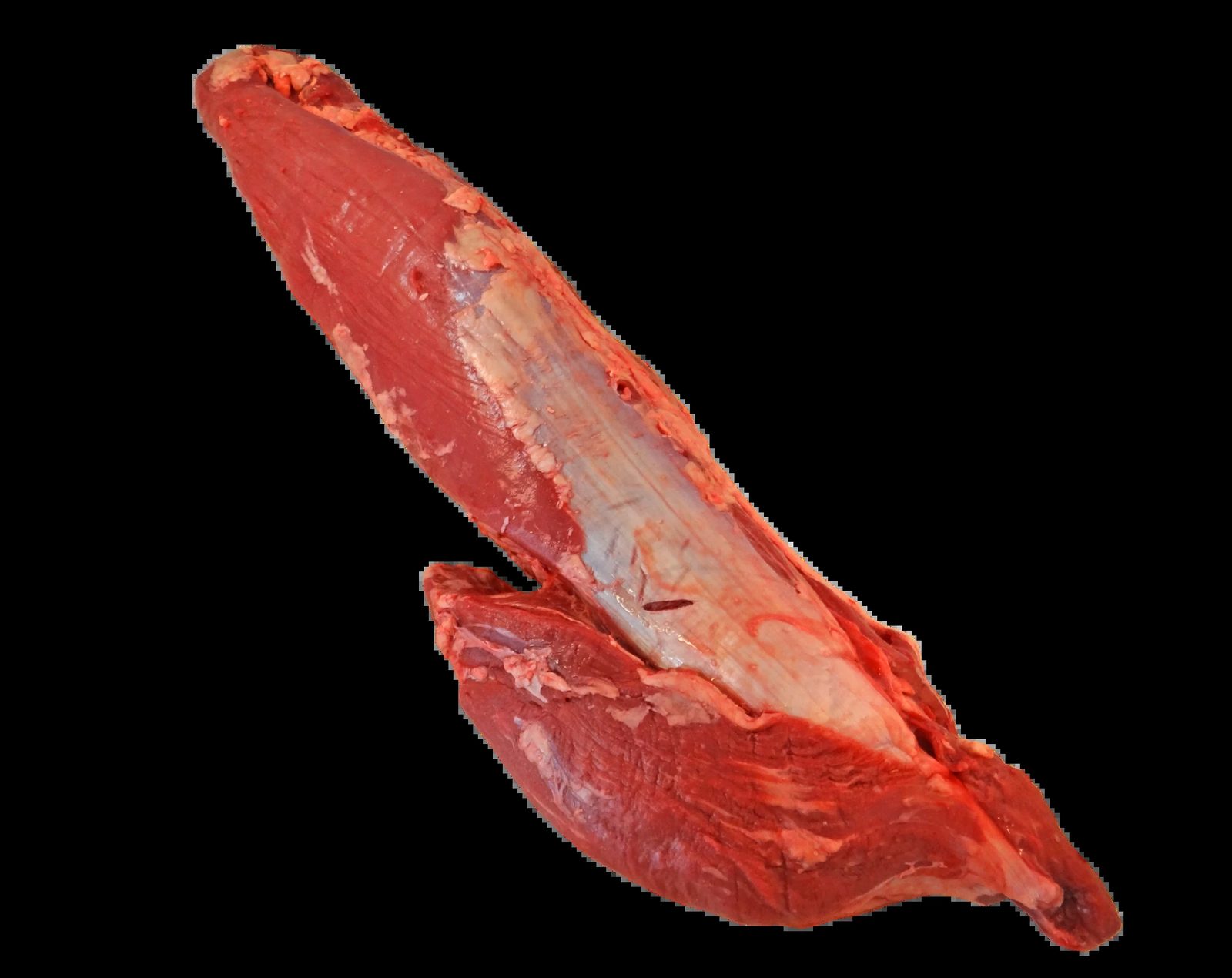
Sirloin. The sirloin lies between the short loin and the round and holds part of the backbone and hipbone. Its roasts and steaks, with or without bone, are tender and flavorful, though not as tender as the strip loin, and are cooked by dry heat. Sirloin comes as top and bottom sirloin; the bottom is often ground, or cut into chunks to stew or braise.
Flank. The flank, under the loin, has no bones. It is flavorful but not tender, with plenty of fat and connective tissue, so most of it is trimmed and ground. Two pieces are kept: the flank steak, also sold as London broil, and the hanging tenderloin, which is not really part of the tenderloin but is very tender and can be cooked any way.
Round. The round is the hind leg. It can weigh up to 200 pounds (90 kg). Its subprimals are the top round, the knuckle, the shank, and the outside round and eye round, which together are called the bottom round. Steaks from the round are less tender. Because the top round and knuckle have large muscles with little fat between them, they roast well. Braising suits the bottom round best, and the hind shank is cooked like the fore shank.
When buying bottom round, look for:
- a short, thick piece with some fat on it;
- bright cherry-red meat;
- flecks of fat through the muscle;
- a firm feel.
Long, lean pieces tend to be tougher and less tasty.
Buyers order beef by number from a standard list, the IMPS numbers: 189 for a tenderloin, for example, 180 for a strip loin and 120 for a brisket.
Trimming and butterflying
Many kitchens buy beef already cut, but a cook still needs to be able to break it down. To trim a whole tenderloin:
- Pull and cut away the loose fat to uncover the meat.
- Take off the chain muscle that runs along one side. It is full of connective tissue, but trimmed, its meat can be used in other dishes.
- Remove the silverskin, the thin, shiny membrane. Lift a corner, hold it tight, and slide the knife along under it in long strips, with the blade tilted slightly up toward the skin so no meat is lost.
- Portion it into chateaubriand, filet mignon, tournedos and tips.
To butterfly a boneless steak, make a first cut almost all the way through, leaving about ¼ inch (6 mm) joined. Then cut right through to free the steak. It opens out thinner and wider, and cooks faster.
Chicken thighs carry more fat than lean beef cuts such as eye round, top round, top sirloin or a shoulder pot roast. Trim off as much outside fat as you can before cooking and serving.
Sources
This chapter is written from these open textbooks:
- Meat Identification and Fabrication — Welsh & Thibodeaux, Finch Henry Job Corps Center & Nicholls StateCC BY-NC-SA 4.0
- Garde Manger: A Guide to the Cold Kitchen — Welsh & Thibodeaux, Finch Henry Job Corps Center & Nicholls StateCC BY-NC-SA 4.0
- Basic Scientific Food Preparation Lab Manual — Dept. of Food Science and Human Nutrition, Iowa State UniversityCC BY-NC-SA 4.0
- Food Safety, Sanitation and Personal Hygiene — BC Cook Articulation Committee, BCcampusCC BY 4.0