Chapter 20 · Salt, herbs and spices
20.3 Spices
Ground spices give up their aroma to the air, so they fade if they are left open. Keep them sealed when not in use. Whole seeds and beans last longer, but they need sealed containers too.
Good cooking uses many textures and tastes. Contrast matters as much as harmony, but avoid extremes, and keep the dish in balance. see chapter 6: Describing flavor: the flavor profile
Peppercorns
True pepper comes from the berries of a vine, piper nigrum, that is native to tropical Asia. It has nothing to do with chile peppers. Peppercorns differ in size, color, heat and taste, mostly because of differences in climate and growing conditions. Good pepper is costly. Buy it whole and grind it in a pepper mill as you need it. Whole peppercorns kept dry will last forever; store them covered, somewhere cool and dark.
- Black pepper. The berries are picked green and dried whole in the sun. Warm and pungent. Tellicherry peppercorns, grown on India's southwest coast, are thought the finest black pepper in the world, and cost the most.
- White pepper. The same plant, but the berries are left to ripen until red, allowed to ferment, and then washed free of their skin. Some white pepper is made instead by rubbing the skin off black peppercorns by machine; that is not true white pepper and should be labeled "decorticated". White pepper has less aroma than black. Use it in white sauces, or wherever black flecks would spoil the look.
- Green peppercorns. Unripe berries, either pickled (in vinegar or brine) or freeze-dried. Pickled ones are soft and fresh and sour, a little like capers; good in spiced butters, in sauces and with fish.
- Pink peppercorns. Not pepper at all, but the berries of a South American tree. Sold dried or pickled. Pretty, but bitter and piny, and less hot than true pepper.
- Szechuan pepper. The dried red berries of the Chinese prickly ash tree, also called anise pepper or Chinese pepper. Very hot, with a citrus edge. Used in Chinese cooking and in five-spice powder.
Black pepper is one of the spices that can turn bitter if it cooks for a long time.
Chiles
Paprika, chile peppers, bell peppers and cayenne all belong to the capsicum family. They were grown for thousands of years in the Americas and the West Indies, but the Old World did not know them until the Spanish voyages of the 15th century. Capsicums run from sweet to fiercely hot. Some are cooked as vegetables; others are dried and ground into spices.
- Cayenne. Sometimes labeled just "red pepper". A fine, bright orange-red powder ground from a mix of very hot dried red chiles. Extremely hot and pungent.
- Paprika (Hungarian pepper). A bright red powder from particular red chiles, ripened and dried. It ranges from sweet to pungent and has a strong smell of its own. Many dishes of Spain and eastern Europe depend on it. Mild paprika is meant to be used freely and can be dusted over finished food as a garnish.
- Chile powder and chili powder. Pure chile powder is dried chiles, simply roasted, ground and sieved, and it can be mild or very hot. Commercial chili powder, an American invention, is a blend: chiles with oregano, cumin, garlic and other flavorings, meant for Mexican dishes. Every brand differs, so taste it before you cook with it.
- Crushed chiles (chile flakes). Dried chiles broken into coarse pieces. Quite hot; used in sauces and meat dishes.
- Aleppo pepper (Halaby pepper). Bright red chiles from Turkey and northern Syria, dried in the sun, seeded and crushed. Sharp but sweet and fruity, with only mild heat, rated at 15,000 Scoville units. Though it is a capsicum, cooks use it more the way they use ground black pepper, as a Mediterranean condiment.
Saffron, vanilla and other costly spices
Saffron is made of the dried, thread-like stigmas of the saffron crocus flower. Each flower has only three, and each is picked by hand. About 250,000 flowers make one pound, which is why it is the dearest spice in the world. In short, "there is no such thing as cheap saffron."
Happily, a small pinch colors and flavors a large pot. Good saffron is a brilliant orange, not yellow, with a strong smell and a bitter, honey-like taste, and it turns any warm liquid yellow. Spanish (Valencia) saffron is thought the best. It belongs with fish and shellfish, where bouillabaisse cannot do without it, and with rice dishes such as paella and risotto. Crush the threads gently, then soak them in a little of the recipe's hot liquid before adding them. Powdered saffron costs less and can go straight in, but it is easier to fake.
Vanilla takes its name from the Spanish vaina, a pod. It comes from an orchid-like plant native to Central America, and curing the beans is a complicated job, which is why real vanilla is expensive. Cured pods should be black and packed in airtight boxes.
- Using the bean. Split the pod lengthwise and scrape out the seeds, which carry the flavor. Or simmer the split pod in the milk or cream for a dessert. One use does not exhaust it: drain it, freeze it and use it again. A bean left in a jar of icing sugar flavors the sugar for cookies and cakes.
- Extract. Pure vanilla extract is better than imitation. Imitation vanilla is made from vanillin, a colorless synthetic crystal, and it is three to four times as strong as real vanilla, so use it sparingly.
- Heat. Vanilla extract starts to evaporate from about 138°C (280°F). That makes it a poor choice for flat goods like cookies, but fine in cakes, whose insides stay cooler.
Cardamom costs more than any spice but saffron. Ground cardamom loses its flavor quickly and is easy to adulterate, so buy whole seeds and grind them yourself as needed.
Handling spices well
- Nutmeg. Grate a whole nutmeg straight into the dish when you need it. Once grated it loses flavor fast, and a little goes a long way.
- Cloves. Their hard, sharp points let you press whole cloves into an onion or a piece of fruit to flavor it. They are very strong, so use only a few.
- Cinnamon sticks. Use them where a long cooking time gives the flavor time to come out, as in stews and curries. Ground cinnamon is the usual buy, because the bark is hard to grind.
- Cinnamon sugar. Stir about 50 g (2 oz.) of cinnamon into each kilogram (2.2 lb.) of white granulated sugar.
- Anise seed. When the seeds turn brown they are stale; throw them out.
- Filé powder. It goes stringy if it boils, so add it only in the last few minutes of cooking.
- Horseradish. Heat kills its bite, so add it near the end of cooking. Choose firm, plump roots; they only smell of horseradish once cut or bruised. Throw away the outer skin and the inner core, which can taste unpleasant. Serve it grated, creamed into a sauce, or worked into a compound butter or a mustard.
- Tamarind. Soak the sticky block of pods, pulp and seeds for roughly five minutes in warm water, then push it through a sieve. It also comes as a concentrate.
- Capers. Keep them in their own liquid and they last a long time. Do not top them up with fresh vinegar or swap the liquid, or they will spoil.
- Fresh ginger. Choose plump, firm roots with smooth skin. Refrigerated, they keep about a month.
- Chili powder. Taste each brand before using it.
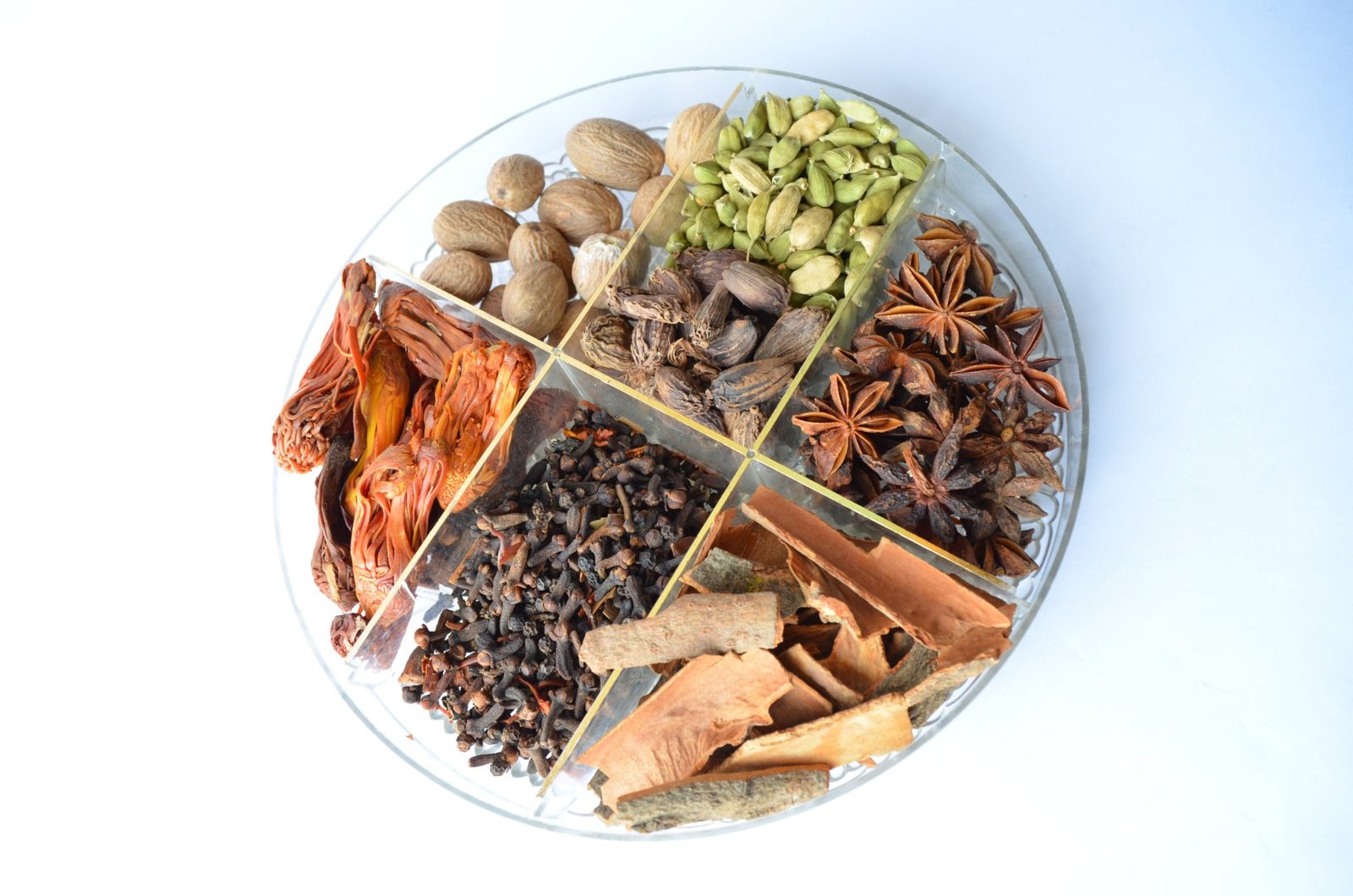
A guide to the spices
| Spice | What it is | What it is like | Where cooks use it |
|---|---|---|---|
| Allspice | Berries of a small tropical evergreen, picked green and dried in the sun until reddish-brown; grown mainly in Jamaica | One spice that tastes like cloves, nutmeg and cinnamon together | Ground, in cakes, cookies and pies. |
| Anise | Small gray-green seeds of a parsley-family plant | Strong and sweet, like licorice and fennel | Pastries, breads, cookies and candies; fish, shellfish and vegetables; anise drinks such as ouzo. |
| Star anise (Chinese anise) | The dried, star-shaped fruit of a magnolia tree from China; no relation to anise | Like anise but more bitter and pungent | Many Chinese dishes; part of five-spice powder. |
| Annatto | Small brick-red seeds of a South American and Caribbean shrub | Mild and peppery; colors food yellow-orange | Rice, fish and shellfish; crushed for Mexican achiote paste; a natural coloring for cheese and margarine. |
| Asafetida | A pale brown resin made from sap; the plant, native to India and Iran, looks like a giant fennel | Garlicky, with a foul smell that does not pass to the food | Indian and Middle Eastern food, in very small amounts. |
| Capers | Pickled unopened flower buds of a wild Mediterranean bush | Sharp, salty and sour, a flavor that comes only from curing in salted white vinegar. The smallest, nonpareils from Provence, are the finest. | Sauces such as tartare and remoulade; fish and game. |
| Caraway | Small crescent-shaped brown seeds; perhaps the oldest spice, traced back to the Stone Age | Peppery, like rye | German and Austrian breads, meats and cabbage; rye bread, cookies, cakes, cheeses and drinks. |
| Cardamom | Tiny dark seeds in a pod, from the ginger family | Strongly aromatic, lemony with a note of camphor | Indian and Middle Eastern food and coffee; Scandinavian breads and pastries; Danish pastries, coffee cakes and holiday baking. |
| Cinnamon | Thin bark of a small evergreen, peeled and dried in the sun; the best is pale brown, rolled into quills | Subtler than cassia | Pastries, breads, puddings, cakes, candy and cookies; also lamb and spicy dishes. |
| Cassia (Chinese cinnamon) | A coarser bark, close kin to cinnamon | Darker, sharper and stronger; cheaper than cinnamon | Better for savory food than sweet. In the United States, much so-called cinnamon is really cassia, since labels need not say which. |
| Cloves | Flower buds of a tropical evergreen, dried before they open | Sweet, pungent and very strong | Desserts, meat dishes, preserves; ground in mincemeat, fruit pies and plum pudding. |
| Coriander | Round beige seeds of the cilantro plant | Sweet, spicy and strongly scented; nothing like cilantro leaves | Indian food and pickling mixtures. |
| Cumin | Small seeds of a parsley-family plant from North Africa and the Middle East; they look like caraway | Strong and earthy; tends to take over a dish | Indian, Middle Eastern and Mexican food; sausages and some cheeses. |
| Fennel seed | Ridged greenish-brown seeds of the plant whose bulb is eaten as a vegetable | Like anise, but less sweet | Italian stews and sausages; fish, pork, pickles and vegetables; ground in breads, cakes and cookies. |
| Fenugreek | Small pebble-shaped seeds of a bean-like plant | Bittersweet, like burnt sugar, with a bitter finish; tints food pale orange | Indian curries and chutneys. |
| Filé powder | Dried, ground sassafras leaf, long used by the Choctaw | Spicy | Thickens and flavors Cajun and Creole dishes such as gumbo; also a table condiment. |
| Galangal (Thai or Laos ginger) | A rhizome, or underground stem, with reddish skin and pale or orange flesh | Peppery and ginger-like, smelling of pine | Peeled and crushed for Thai and Indonesian food. Fresh ginger can replace it. |
| Ginger | The knobbly rhizome of a tropical plant; a fresh piece is called a "hand" | Fresh: hot but sweet, with lemon and rosemary notes. Ground: spicier and less sweet. | Fresh in Indian and Asian food, with chicken, beef and curries; ground in gingerbread, fruitcake, cookies and pies; also pickled, candied, or kept in syrup or alcohol. |
| Grains of paradise (Guinea or Melegueta pepper) | Seeds of a West African reed-like plant, related to cardamom | Warm, spicy and a little bitter, like pepper; once used instead of black pepper | West African and North African (Maghreb) dishes; ras el hanout. |
| Horseradish | Large off-white root of a cool-climate plant, not related to radishes | Pungent | Russian and Central European food; roast meat, fish and shellfish. |
| Juniper | Round purple berries of an evergreen bush | Sweet and pine-like | Flavors gin; crushed into game such as venison and wild boar. |
| Mustard seed | Small hard seeds, yellow, brown or black, from three cabbage-family plants | No smell, but sharp and hot; yellow is mildest, black strongest | Pickling spice; prepared mustards. Ground mustard is a yellow powder of seeds, wheat flour and turmeric. |
| Nutmeg | The seed inside the fruit of a large tropical evergreen; it looks like a smooth piece of wood | Strong and sweet | Pastries and sweets, custards, puddings, spice cakes, doughnuts; meat and savory dishes too. |
| Mace | The lacy coating around the nutmeg seed | Like nutmeg, but more refined and costly; keeps its flavor longer than most ground spices | Pastry, pound cake, breads and puddings. Usually sold ground. |
| Poppy seed | Tiny hard blue-gray seeds of the opium poppy; ripe seeds hold none of the plant's drugs | Sweet and nutty | Breads, rolls, cakes, cookies and pastry fillings. |
| Sesame (benne) seed | Small, flat, creamy-white seeds | Nutty and earthy; stronger when roasted or ground into tahini, a paste | Breads, buns and meat dishes; a black kind is a Japanese condiment. Pressed for sesame oil, which does not go rancid easily. |
| Tamarind (Indian date) | Brown bean-shaped pod of an African tree | Sweet, yet very sour from its 12% tartaric acid | Souring agent in Indian curries and Mediterranean food; West Indian fruit drinks; chutneys and jams, thanks to its pectin; barbecue sauce, marinades and Worcestershire sauce. |
| Turmeric (Indian saffron) | Rhizome of a plant related to ginger, usually sold dried and ground | Mild woody smell; strong taste; bright yellow | Indian curries; a food coloring and dye. Never a substitute for saffron. |
| Wasabi | Pale green root, like horseradish but unrelated | Sharp, clean and herbal, a little hotter than horseradish | Sushi and sashimi; a spicy note in mashed potatoes or compound butter. Fresh wasabi is rare outside Japan; powder and paste are easy to find. |
Sources
This chapter is written from these open textbooks:
- Culinary Foundations — Cheramie & Thibodeaux, Chef John Folse Culinary Institute, Nicholls StateCC BY-NC-SA 4.0
- Fruits, Vegetables and Farinaceous Products — Thibodeaux & Bienvenu, Chef John Folse Culinary Institute, Nicholls StateCC BY-NC-SA 4.0
- The Chemistry of Cooking — Sorangel Rodriguez-Velazquez, LibreTextsCC BY-NC-SA 4.0
- Food Safety, Sanitation and Personal Hygiene — BC Cook Articulation Committee, BCcampusCC BY 4.0