Chapter 1 · The cook's trade
1.2 The brigade and who does what
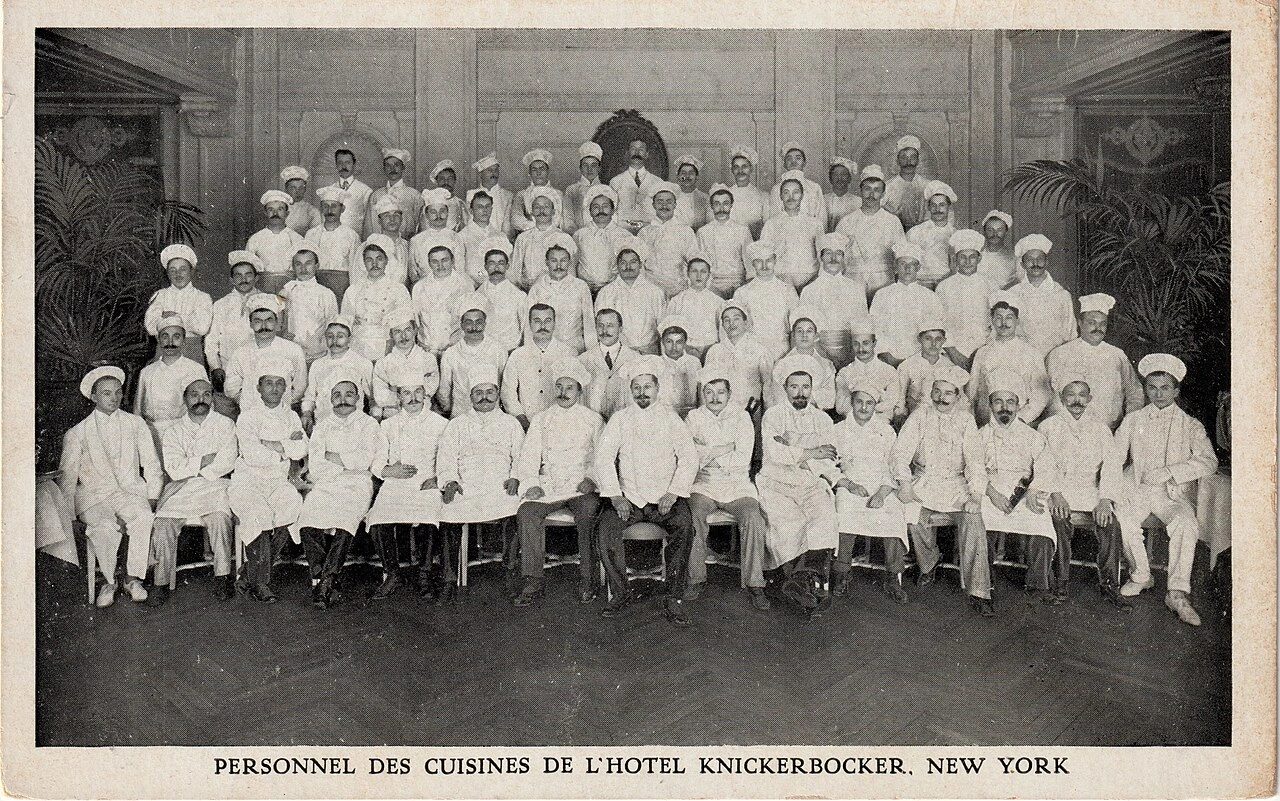
Many of the job titles in a professional kitchen are of French origin. That is no accident: the restaurant as a business took its modern shape in Paris around the time of the French Revolution, and the brigade kitchen labor system that still organizes big kitchens was the work of a renowned French chef, Auguste Escoffier.
Ranks in the classic brigade
- Chef de cuisine: also called the executive chef. The head of the whole kitchen, its general.
- Sous chef: the under-chef and second in command. Supervises and coordinates the station chefs, and takes over when the chef de cuisine is away. During service the sous chef may also work as the expediter, or aboyeur. Usually this cook is training to become a head chef.
- Chef de partie: a station chef. Each one is responsible for one part of the meal, and stations are split up by the ingredients they handle or by the cooking method they use. Several demi-chefs and commis usually work under each one.
- Demi-chef: an assistant station chef. Does most of the real cooking at the station, under the chef de partie, and runs the station when that chef is away.
- Commis: an attendant placed at one station and given the plainer, lower-skill jobs. A commis is usually training to become a demi-chef.
- Apprentice: the lowest rank. Apprentices do the heavy lifting while they study, and they work through every station so that they are ready to move up to commis and beyond.
The stations
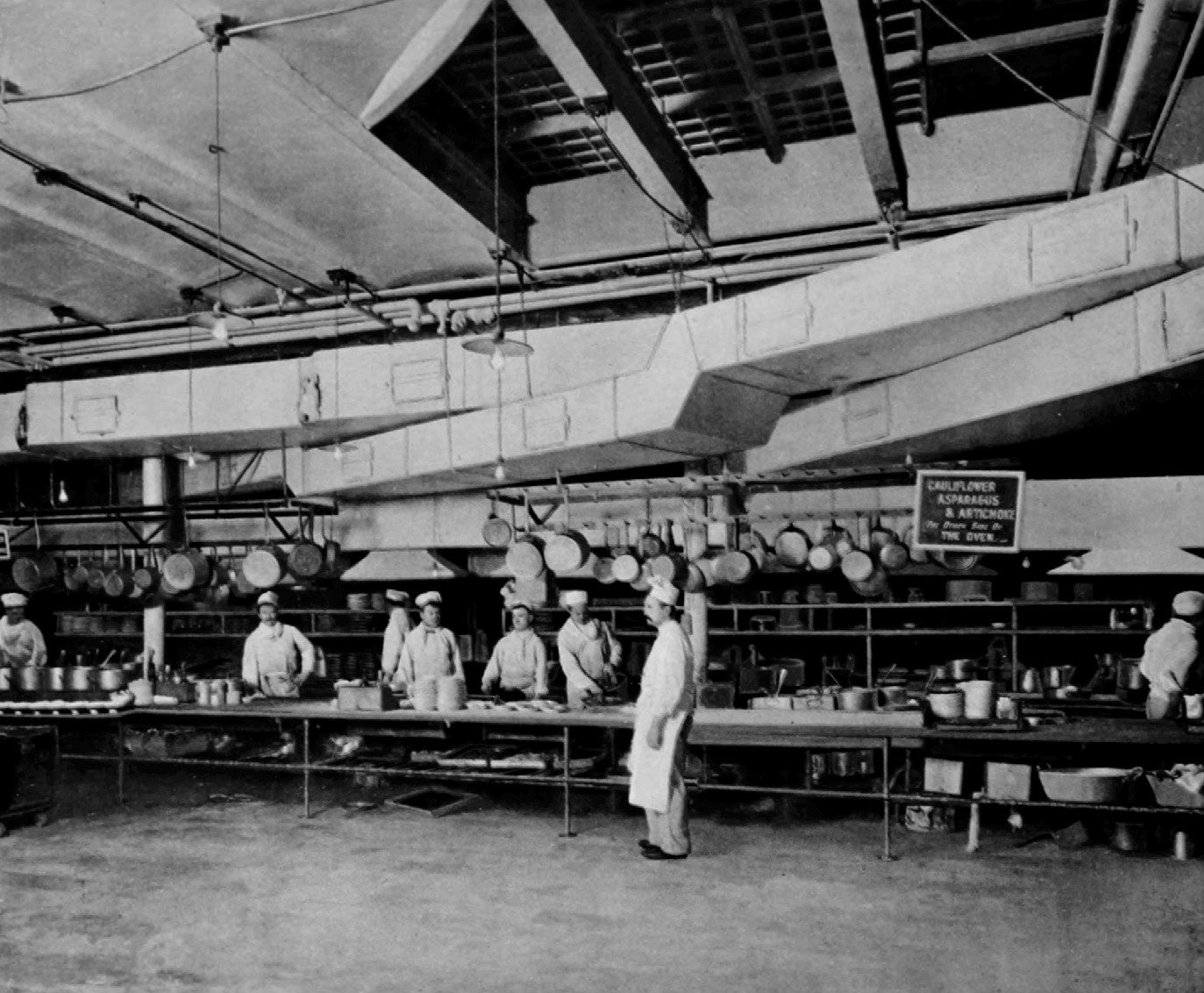
Not every kitchen has every station, but a kitchen will include some of these.
| Station | Who makes what |
|---|---|
| Saucier | sautéed dishes |
| Poissonier | fish and shellfish |
| Friturier | fried food, mostly deep-fried |
| Grillardin | grilled and broiled food |
| Rotisseur | roasts, braises, and the stuffings that go in them |
| Potager | stocks and soups; helps the saucier and is seen as a lower-skill post |
| Legumier | vegetable dishes |
| Entremetier | the potager's and legumier's work together: vegetables, soups and stocks |
| Garde manger | cold food of every kind: salads, cold meats, pâtés, terrines, sausages, hors d'oeuvres, carved garnishes and buffet items |
| Boucher | butchering meat and preparing poultry and fish; may hand them on to the garde manger to share out among stations |
| Charcutier | pork products: hams, sausages, rillettes, pâté, pâté en croûte and other cured meats; may work with the garde manger |
| Patissier | pastry; heads the confiseur (petits fours and candies), the glacier (cold and frozen desserts, and perhaps ice sculptures), the decorateur (decorated cakes) and the boulanger (breads, rolls and cakes) |
The modern brigade
Few restaurant kitchens today use the full classic brigade. It is still found where cooks turn out huge amounts of food, such as on big cruise ships.
- Executive chef: the top chef, in charge of everything in the kitchen. Writes the menu, orders supplies, manages the staff, and reports to the owners or managers. An executive chef may run several kitchens, for example in a hotel or resort with more than one restaurant. In some places the executive chef spends much of the day cooking rather than doing paperwork.
- Chef de cuisine: the head chef of one kitchen. Reports to the executive chef, or to the owner when the owner runs the kitchen. Sometimes one person holds both jobs.
- Sous chef: next in line, and in charge whenever the head chef is not there. Watches over how dishes are prepared, portioned and presented, so that each one meets the head chef's standard.
- Area chefs: the modern station chefs, each responsible for one area of the kitchen. They may have line cooks under them, or the line cook and the station chef may be one job. In modern kitchens these duties may rotate.
- Line cooks: work for an area chef and hold one position in that area.
- Expeditor (aboyeur): takes the orders from the servers, calls them out to the kitchen, and keeps every dish moving together. May check each finished plate and add the last touches, then makes sure servers take plates out quickly and correctly, sometimes carrying them out personally.
A busy kitchen also needs dishwashers and other workers who do not appear in any brigade chart.
The garde manger: keeper of the food
The name garde manger means keeper of the food. Before the French Revolution, the garde manger worked in castles with no refrigerator and no air conditioning. Meat was kept in the coolest part of the lower floors, perhaps chilled by the water of the moat. Pig, deer, rabbit and birds from the forest were preserved so that they kept longer, filled people up and were worth more. In Carême's time, ice was sawn from frozen lakes in winter and stored underground, packed in straw and dirt.
The old skills are popular again. Chefs are making charcuterie, a word that means cooked flesh, and serving it on boards with cheese. Some build layered salads set in aspic, or add a gelée that melts on the tongue to give a cold dish moisture. The cold kitchen runs from everyday cold food to competition platters and molecular gastronomy.
A modern commercial kitchen uses heavy machines, and each one must be learned: how it goes together, how it comes apart, how to clean it and how to store it.
- Food processor: blends, purées, slices and grates. The usual mistake is pulling the bowl off before taking the lid off, which breaks the pin in the bowl handle that connects to the motor.
- Tabletop mixer: the cold kitchen uses 5-quart and 20-quart sizes to mix sausage meat with fat and spices.
- Meat slicer: cuts bacon, salami, speck and other charcuterie into even slices. It is dangerous. Wear the right gloves and clean and sanitize it fully, on schedule.
- Buffalo chopper: a fast, high-volume chopper. In the cold kitchen its main job is the smooth meat paste for emulsified sausages such as frankfurters. The bowl turns while the blade spins, and ice keeps the cold emulsion from breaking. Sanitize it before use, then clean, sanitize and put it back together after.
- Vacuum sealer: seals food for sous vide, storage, curing and freezing. Check it for lubrication regularly.
- Sausage stuffer: comes with tubes in different sizes for different casings and kinds of sausage.
- Meat grinder: a screw called the worm, or auger, carries the meat forward to the blade and pushes it through the die, which sets the size of the grind. Chill the parts first and put them together correctly.
What the work asks of a cook
Hospitality means working so that other people can play. Holidays are busy days. Dinner starts after 5 p.m., just as most people finish work. Weekends belong to the guests, so a cook's days off, if there are any, are often Monday and Tuesday. Put plainly, "Strong work ethic is the price of admission in food service."
The people who accept this join a hard-working, fun-loving group who enjoy making others happy. Those who cannot accept it usually move on.
Other traits that serious cooks and chefs share are listed below.
- Dependable. This matters more than anything else. A good cook turns up when needed, never lets quality slip, and puts the team and the business first.
- Competing with themselves. The best cooks are never satisfied with today. They ask how even a well-liked dish could be better.
- Goal driven. A small goal and a goal that could make or break the restaurant get the same effort: meet it or beat it.
- Creative and willing to dream. Guests are mostly served food they feel safe with, but chefs also bring in new dishes that guests learn to love, which keeps a restaurant growing.
- Pushing others. Good cooks critique the people around them, always with a solution, and remind everyone of the big picture.
- Organized. Without order a kitchen is chaos. Mise en place, gathering and readying everything a recipe needs before cooking starts, is the first skill a cook learns.
- Loyal. Cooks look out for each other, even beyond their own kitchen; anyone who wears kitchen whites can count on the support of others who do.
- Street smart. They can tell truth from nonsense and opportunity from danger, which helps a cook become a good leader.
- Using all five senses. Cooks plan for taste, touch, sight, smell and sound in a meal.
- Storytellers. A chef's menu tells the story of a career and of the dishes that mattered, and it shows which preparations the chef is comfortable with.
- Proud. Cooks are proud of their work, their skills, their team and what they do for others.
Good habits in a working kitchen
A training kitchen runs on a few simple habits, and they carry straight into a career.
- Learn what each piece of equipment is and where it lives. Put tools back in their place after use, so the next person can find them. An organized kitchen means lower labor costs, happier customers and bigger profits.
- Arrive in full uniform. Wash your hands, then set up your station and sanitize the work area, your knives and your cutting board.
- Write a game plan before you cook: the ingredients, the equipment and each step of the recipe. Then you do not lose time reading the recipe while you cook. Picturing the steps in your head as well as practicing them helps you succeed.
- Gather all your mise en place in pans before you begin.
- Leave your phone alone, keep talk to what the work needs, and tell the chef before you step away.
- Wash dishes as you go rather than leaving them piled at the sink.
- Think one step ahead. Hot food goes on warm plates and cold food on cold plates.
- Keep a good attitude and take criticism well. Everyone makes mistakes, and a classroom is a better place to make them than a restaurant.
- Keep using what earlier lessons taught you. Do not wash away the suc, or fond, in the pan when a dish needs it for flavor; keep up sanitation every day, not just for the inspector.
Sources
This chapter is written from these open textbooks:
- Culinary Foundations — Cheramie & Thibodeaux, Chef John Folse Culinary Institute, Nicholls StateCC BY-NC-SA 4.0
- Modern Pastry and Plated Dessert Techniques — BC Cook Articulation Committee, BCcampusCC BY 4.0
- Garde Manger: A Guide to the Cold Kitchen — Welsh & Thibodeaux, Finch Henry Job Corps Center & Nicholls StateCC BY-NC-SA 4.0